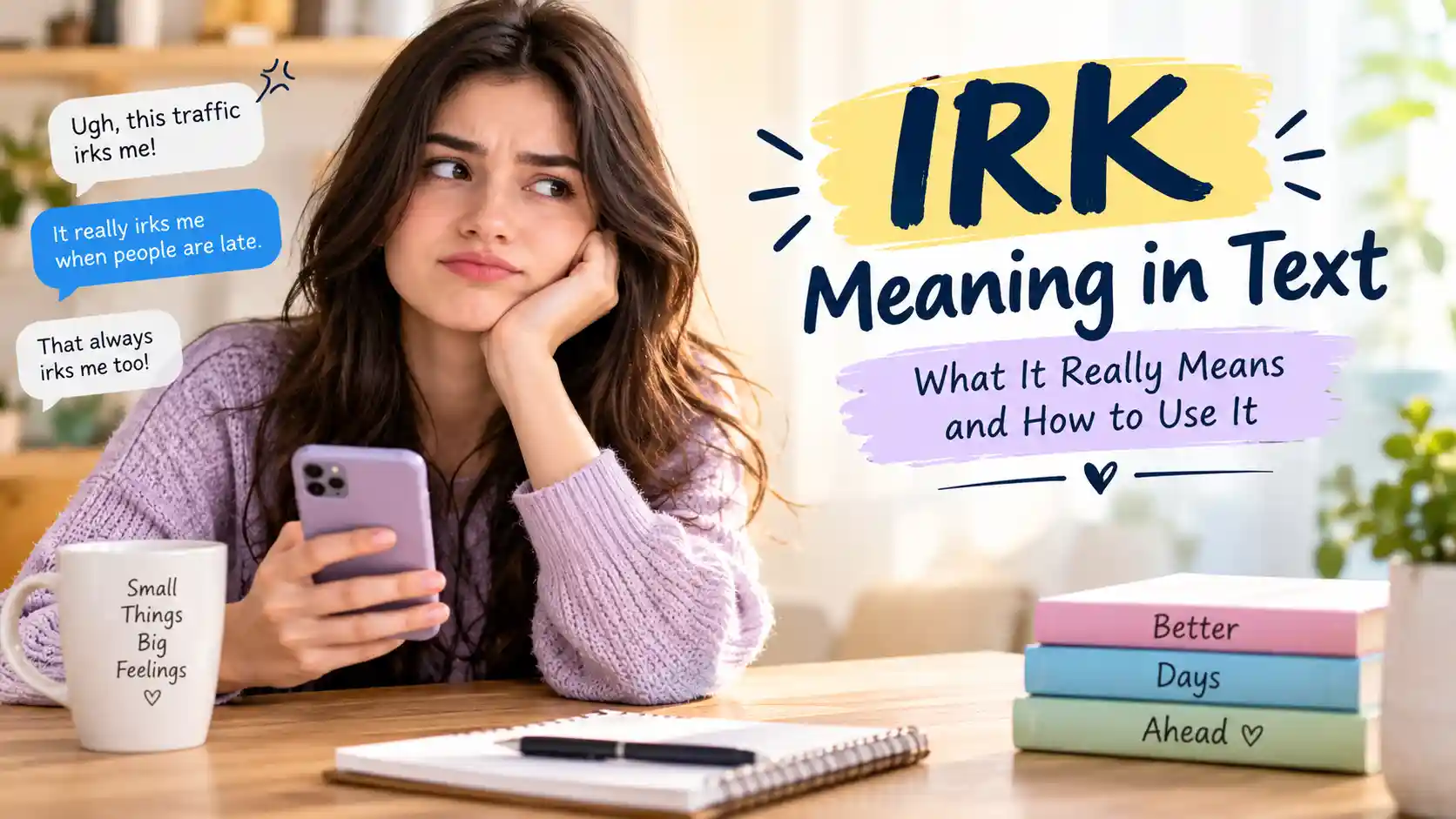
Have you ever seen someone text “that irks me” and wondered exactly what they meant? You’re not alone. While “irk” isn’t a newer internet acronym, it’s a word that shows up often in casual texting, social media, and everyday conversation, especially when someone wants to express mild annoyance.
Irk means to annoy, bother, or irritate someone, usually in a mild or moderate way rather than describing intense anger. You’ll see it in texts, captions, tweets, and casual chats whenever someone wants to express a small frustration without sounding overly dramatic.
Understanding irk matters because it fills a specific emotional space, stronger than simple mild dislike, but softer than genuine anger. This guide breaks down everything about irk, from its exact meaning to how it’s used naturally across different conversations.
IRK in Text Meaning: Definition & Real-Life Examples
Irk means to annoy, irritate, or bother someone, typically describing a mild to moderate level of frustration rather than intense anger. It’s often used to describe small, everyday annoyances rather than major conflicts.
Example:
Maya: It really irks me when people chew loudly.
Jake: Same, that’s such a pet peeve of mine too.
It’s commonly used as a verb, describing the act of annoying someone, or as part of the adjective form “irked,” describing someone’s current irritated state.
Example (verb form):
Zoe: His constant interrupting irks me so much.
Ben: Yeah, that would bother me too.
Example (adjective form):
Sam: I’m a little irked that he canceled last minute again.
Ali: Totally understandable, that’s happened a few times now.
Irk typically describes:
- Minor daily annoyances small habits or situations that bother someone
- Mild frustration a feeling less intense than anger, but more than simple indifference
- Pet peeves specific, recurring things that consistently bother someone
Example (pet peeve):
Friend: What’s something that really irks you?
You: Honestly, when people don’t reply to texts for days.
The core meaning stays consistent: irk describes a feeling of mild annoyance or irritation, usually about something relatively small.
The History Behind IRK in Text Meaning
Unlike many modern texting acronyms, “irk” isn’t new internet slang, it’s a genuine English word with roots dating back centuries. The word traces back to Middle English, with origins possibly linked to Scandinavian languages, used to describe feelings of weariness, annoyance, or irritation long before texting or even modern English as we know it existed.
Over the centuries, “irk” remained a stable, consistently used word in English, appearing in literature, formal writing, and everyday speech to describe mild frustration. Unlike slang terms that rise and fall in popularity, irk has maintained a steady, modest presence in the English language without significant shifts in meaning.
As texting and social media became dominant forms of communication, irk carried over naturally into digital conversations, since it’s a concise, expressive word that efficiently captures a specific emotional tone, stronger than mild dislike, but softer than genuine anger or rage.
Today, irk remains common across:
- Casual texting, describing everyday annoyances
- Social media captions and posts, expressing mild frustration
- Conversations about pet peeves, both online and offline
- Written communication generally, including semi-formal contexts
Its long history as a standard English word means it carries a certain timeless quality that many internet-specific slang terms don’t have.
IRK in Text Meaning Across Different Platforms
Texting (daily annoyance):
Dan: It irks me when people walk slowly in groups blocking the sidewalk.
Ella: Ha, that’s such a universal annoyance.
Social Media (venting mildly):
User1: Things that irk me: slow wifi, loud chewing, and unanswered texts.
Gaming (minor frustration):
Player1: It irks me when teammates don’t communicate.
Player2: Agreed, makes coordinating so much harder.
Casual Conversations (pet peeves):
Noah: What’s something small that irks you?
Ryan: When people leave one square of toilet paper on the roll.
Workplace Chat (mild frustration):
Coworker1: It irks me a little when meetings run over time.
Coworker2: Same here, it throws off my whole schedule.
This shows how flexible irk is, fitting naturally into casual venting, pet peeve discussions, and everyday mild frustrations across many settings.
Common Misconceptions & Clarifications
Misconception 1: Irk means the same thing as “enrage” or “infuriate.”
Not true. Irk describes a much milder form of annoyance, closer to mild irritation than genuine anger.
Misconception 2: Irk is modern internet slang.
It isn’t. The word has existed in English for centuries, long before texting or social media.
Misconception 3: Irk is rude or overly dramatic to use.
Not at all. It’s actually a fairly gentle, almost understated way to express annoyance compared to stronger words like “furious” or “livid.”
Misconception 4: Irk can only describe big problems.
In fact, it’s most commonly used for small, everyday annoyances rather than major issues.
Clarification: Because irk specifically describes mild to moderate annoyance, using it to describe something genuinely serious or distressing might understate the situation, it’s best reserved for everyday pet peeves and minor frustrations.
Similar Terms & Alternatives
| Term | Meaning | Common Use |
| Irk | Mild to moderate annoyance | Texting, casual conversation |
| Annoy | General irritation, similar intensity | Everyday speech and writing |
| Bother | Mild disturbance or inconvenience | Casual conversation |
| Peeve | A specific recurring annoyance | Describing pet peeves |
| Grind my gears | Strong annoyance, more dramatic | Casual, exaggerated speech |
Example:
Alex: Slow walkers in crowded areas really irk me.
Jordan: Honestly grinds my gears too.
These terms often overlap, with irk sitting comfortably in the middle, stronger than simple “bother,” but milder than more dramatic expressions.
How to Respond to This Term
Casual:
Friend: It irks me when people cancel plans last minute.
You: Totally get that, it’s happened to me too.
Funny:
Friend: Loud chewing irks me more than it should.
You: Honestly, valid. Chewing sounds are a universal enemy
Professional:
Irk can work in relaxed workplace conversations, though more formal settings might prefer gentler phrasing:
Coworker: It mildly irks me when meetings start late.
You: Understandable, I’ll make sure to start on time going forward.
Privacy-Conscious:
If someone shares something that irks them and you’re unsure how to respond:
You: That sounds frustrating, I hope it gets better soon.
Matching tone keeps the conversation natural, whether it’s lighthearted complaining or genuine, mild frustration.
Regional or Cultural Differences
Irk is understood consistently across major English-speaking regions, including the USA, UK, and Australia, since it’s a long-standing, standard English word rather than regional slang.
In the UK, irk appears comfortably in both casual and slightly more formal writing, reflecting its established place in standard English vocabulary.
Because it’s a well-established English word rather than internet-specific slang, irk tends to carry a consistent, easily understood meaning across English-speaking countries.
Comparison with Similar Terms
| Term | Formality | Platform | Risk of Confusion |
| Irk | Casual to semi-formal | Texting, writing, speech | Low |
| Annoy | Casual to formal | All contexts | Low |
| Bother | Casual | Texting, speech | Low |
| Peeve | Casual | Texting, casual speech | Low |
The main difference between these terms is intensity and formality. Irk sits comfortably in casual to semi-formal contexts, slightly more expressive than “bother,” but less dramatic than stronger frustration-related words.
Usage in Online Communities & Dating Apps
On Tinder or other dating apps, irk might come up when discussing personality traits, preferences, or pet peeves.
Match: What’s something that really irks you in daily life?
You: Honestly, people who don’t use turn signals while driving.
On Twitter, irk frequently appears in casual posts expressing mild frustration about everyday situations.
User: It irks me how expensive grocery prices have gotten lately.
In gaming communities, especially Discord, irk might describe minor frustrations during gameplay.
Teammate: It irks me when people don’t ping enemy locations.
You: Agreed, communication makes such a difference.
Tip for responding: On dating apps, sharing what irks you can be a fun, relatable way to connect over shared pet peeves and daily frustrations.
Hidden or Offensive Meanings
Irk does not carry any offensive or hidden meaning. It’s a standard, neutral English word describing mild annoyance, with no coded or secretive connotation behind it.
Because its meaning is clear and consistent, there’s little risk of it being misread negatively. The main consideration is simply matching its intensity appropriately, since using “irk” for something genuinely serious might understate the situation, while reserving it for everyday annoyances fits its tone well.
Example:
Friend: It irks me that I keep forgetting my umbrella.
You: Ha, happens to the best of us.
Suitability for Professional Communication
Irk is generally appropriate for professional communication, especially in semi-formal workplace conversations, since it’s a standard English word rather than casual slang.
Appropriate professional use:
“It’s a bit irksome when meetings consistently run over the scheduled time.”
For more formal written communication, such as official emails or reports, slightly more neutral phrasing like “mildly frustrating” or “a minor inconvenience” might feel more polished, though irk itself isn’t considered unprofessional.
FAQs
1. What does irk mean in texting?
It means to annoy, bother, or mildly irritate someone, usually describing a small, everyday frustration.
2. Is irk the same as being angry?
No, irk describes a much milder form of irritation, closer to mild annoyance than genuine anger.
3. Is irk modern slang?
No, it’s a standard English word with origins dating back centuries, long before texting culture existed.
4. Can I use irk in a professional email?
Yes, it’s generally appropriate for semi-formal communication, though more neutral phrasing may suit very formal writing.
5. Does irk always describe small annoyances?
Typically, yes. It’s best suited for minor, everyday frustrations rather than serious or major issues.
6. Is irk used the same way internationally?
Yes, it’s understood consistently across major English-speaking countries like the USA, UK, and Australia.
7. Does irk have any hidden or offensive meaning?
No, it’s a neutral, widely understood word with no hidden or negative connotation.
Conclusion
Irk is a simple, well-established word describing mild to moderate annoyance, perfect for expressing everyday frustrations or pet peeves without sounding overly dramatic. Unlike many internet slang terms, it carries a long history in standard English.
Understanding irk in text meaning helps you express mild annoyance clearly and naturally, whether you’re venting about a small daily frustration, discussing pet peeves with a friend, or casually describing something that bothers you in everyday conversation.

Hello,I am Mahrunnisa, a passionate content writer with 2 years of experience in the meaning niche. I love creating simple, clear, and engaging content about words, phrases, expressions, and abbreviations, helping readers understand meanings easily and confidently.