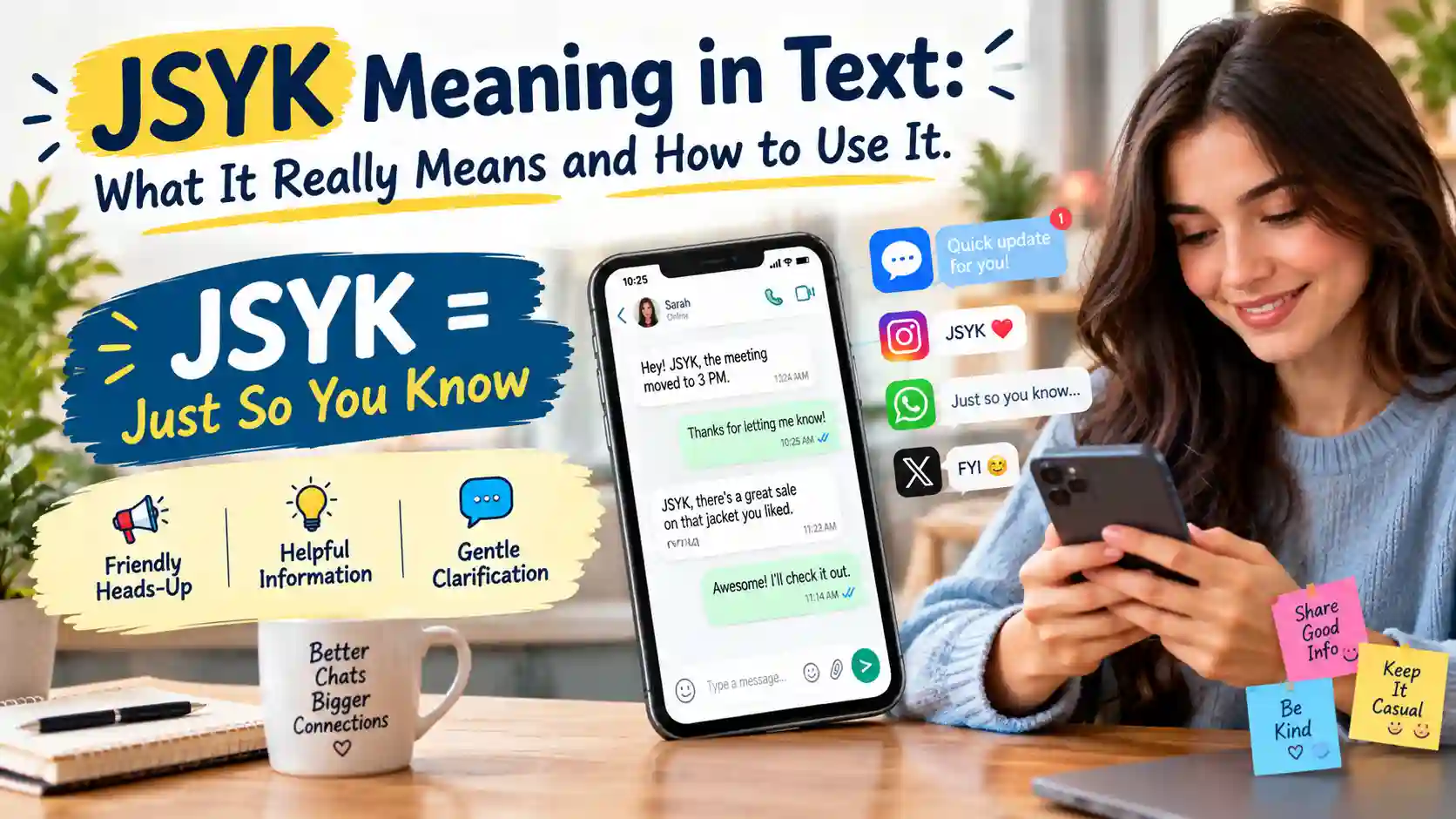
Have you ever seen “JSYK” in a text and wondered exactly what it meant? You’re not alone. This small abbreviation shows up often in casual texting, social media, and group chats, usually right before someone shares a helpful piece of information.
JSYK stands for “Just So You Know.” It’s a quick, friendly way to share information, give a heads-up, or clarify something without sounding overly formal or demanding.
Understanding JSYK matters because it signals tone just as much as content. It softens information, making it feel like a helpful note rather than a correction or command. This guide covers everything about JSYK, from its meaning to how to use and respond to it naturally in different situations.
JSYK in Text Meaning: Definition & Real-Life Examples
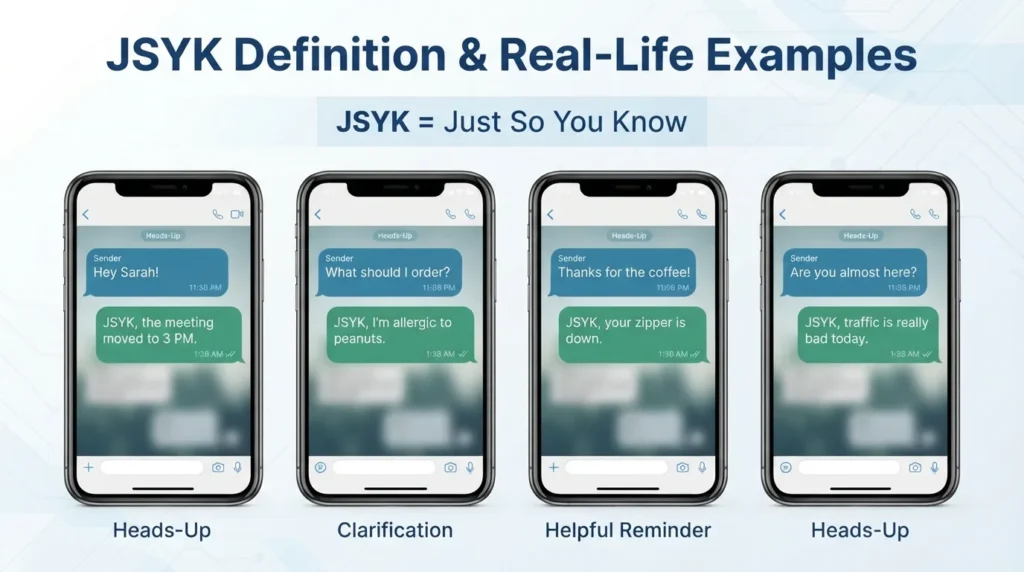
JSYK stands for “Just So You Know.” It’s used to share information casually, often as a friendly heads-up, clarification, or helpful reminder.
Example:
Maya: JSYK, the meeting got moved to 3 PM.
Jake: Thanks for letting me know!
It’s often used to share small, practical updates without sounding overly formal.
Example:
Zoe: JSYK, I’m allergic to peanuts, just in case you’re cooking.
Ben: Good to know, I’ll keep that in mind.
JSYK can also soften potentially awkward or corrective information, making it feel more like a friendly note than criticism.
Example:
Sam: JSYK, your zipper’s been down for a bit.
Ali: Oh no, thanks for telling me!
It’s commonly used to:
- Share practical information updates, reminders, or helpful details
- Give a heads-up about something the other person might not know
- Soften corrections pointing something out gently
Example (heads-up):
Friend: JSYK, traffic is really bad on the highway right now.
You: Thanks, I’ll take the back roads instead.
The core meaning stays consistent: JSYK introduces information in a casual, considerate way, signaling “I’m telling you this to be helpful.”
The History Behind JSYK in Text Meaning
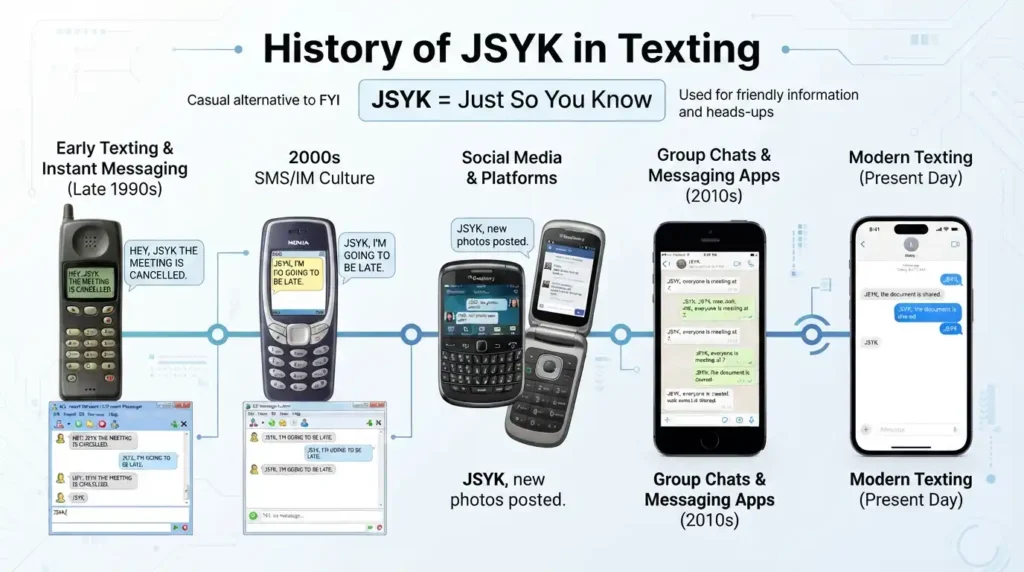
JSYK grew out of early texting and instant messaging culture, following a similar pattern to related acronyms like FYI (“For Your Information”). As mobile texting became widespread in the 2000s, people needed quick ways to share information casually, without sounding overly formal or abrupt.
While FYI has been used in written and business communication since long before texting existed, JSYK developed as a more casual, conversational alternative, better suited to friendly texts between friends and family rather than formal correspondence.
The phrase fit naturally into the broader trend of acronym-heavy texting that emerged alongside SMS messaging and early instant messengers, where character limits and quick typing encouraged shorthand for common phrases.
As texting evolved into social media and group messaging apps, JSYK remained a popular way to share quick updates or gentle reminders among friends, especially in situations where a full sentence might feel unnecessarily formal.
Today, JSYK remains common across:
- Texting between friends and family, sharing quick updates
- Group chats, relaying practical information
- Social media comments, offering friendly clarifications
- Casual workplace messaging, among close coworkers
Its lasting popularity shows how useful, friendly shorthand can stick around even as communication platforms continue to change.
JSYK in Text Meaning Across Different Platforms
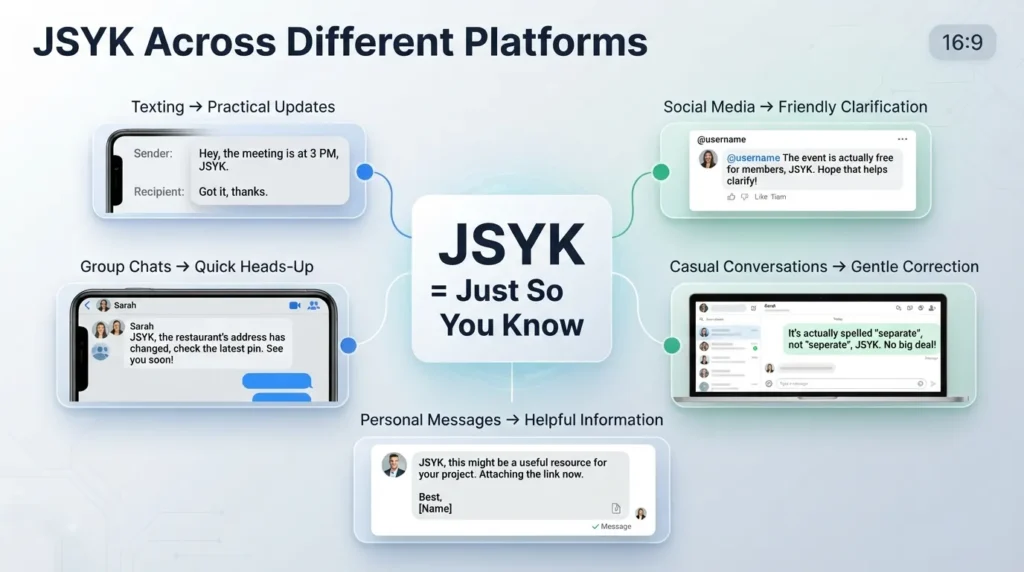
Texting (practical update):
Dan: JSYK, the restaurant closes early on Sundays.
Ella: Oh good thing you mentioned that, thanks!
Social Media (friendly clarification):
User1: JSYK, that sale ends tonight, not tomorrow.
Group Chats (heads-up):
Coworker1: JSYK, the printer on the third floor is out of ink.
Coworker2: Thanks for the warning, I’ll use the one downstairs.
Casual Conversations (gentle correction):
Noah: JSYK, you’ve got a bit of spinach in your teeth.
Ryan: Ha, thanks for telling me before the meeting!
Sharing Personal Information:
Friend: JSYK, I’m trying to eat healthier, so maybe skip the dessert offer this time.
This shows how flexible JSYK is, fitting naturally into practical updates, gentle corrections, and casual reminders across many settings.
Common Misconceptions & Clarifications
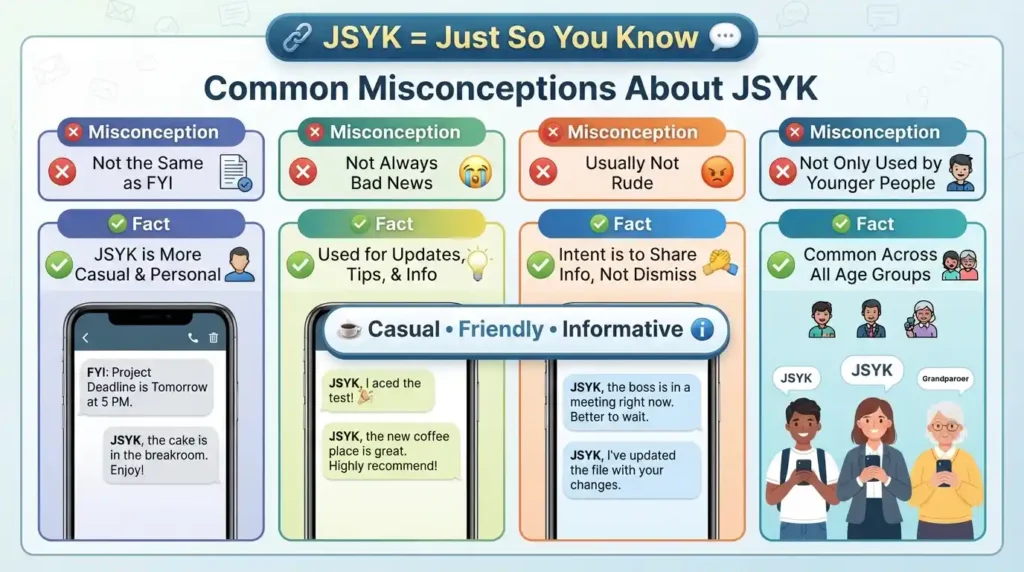
Misconception 1: JSYK is the same as FYI.
They’re very similar, though JSYK tends to feel more casual and personal, often used between friends rather than in formal settings.
Misconception 2: JSYK always introduces bad news.
Not true. It’s used for all kinds of information, practical updates, compliments, reminders, not just corrections or warnings.
Misconception 3: JSYK is rude or condescending.
It’s generally the opposite. It’s meant to soften information and make it feel helpful rather than corrective or bossy.
Misconception 4: JSYK is only used by younger texters.
While common among younger users, it’s widely understood and used across a broad range of ages in casual texting.
Clarification: Because JSYK is meant to sound friendly and considerate, pairing it with a genuinely helpful tone keeps the message from feeling like an unwanted correction.
Similar Terms & Alternatives
| Term | Meaning | Common Use |
| JSYK | Just so you know | Casual texting, friendly updates |
| FYI | For your information | Texting, email, formal and casual use |
| BTW | By the way | Casual texting, adding extra info |
| FWIW | For what it’s worth | Sharing an opinion or minor detail |
| Heads up | A warning or notice | Casual and semi-formal communication |
Example:
Alex: BTW, JSYK, the store closes an hour earlier on weekends.
Jordan: Good to know, thanks for the heads up!
These terms often overlap, all serving to introduce helpful information in a friendly, low-pressure way.
How to Respond to This Term
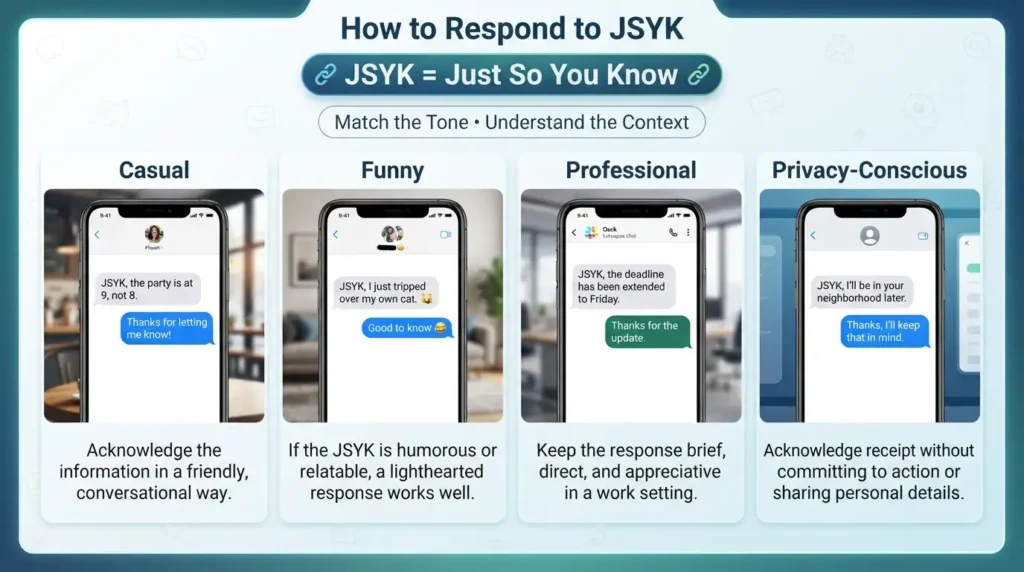
Casual:
Friend: JSYK, the movie starts at 7, not 7:30.
You: Oh perfect, thanks for catching that!
Funny:
Friend: JSYK, you’ve had your camera on mute this whole meeting.
You: Wow, thanks for finally telling me
Professional:
JSYK can work in relaxed workplace chats, though more formal settings usually prefer “FYI” or full sentences:
Coworker: JSYK, the client meeting moved to Thursday.
You: Thanks for letting me know, I’ll update my calendar.
Privacy-Conscious:
If someone shares something personal using JSYK:
Friend: JSYK, I’m taking a break from social media for a bit.
You: Totally understand, take care of yourself.
Matching tone keeps the exchange natural, whether it’s a quick practical update or a more personal heads-up.
Regional or Cultural Differences
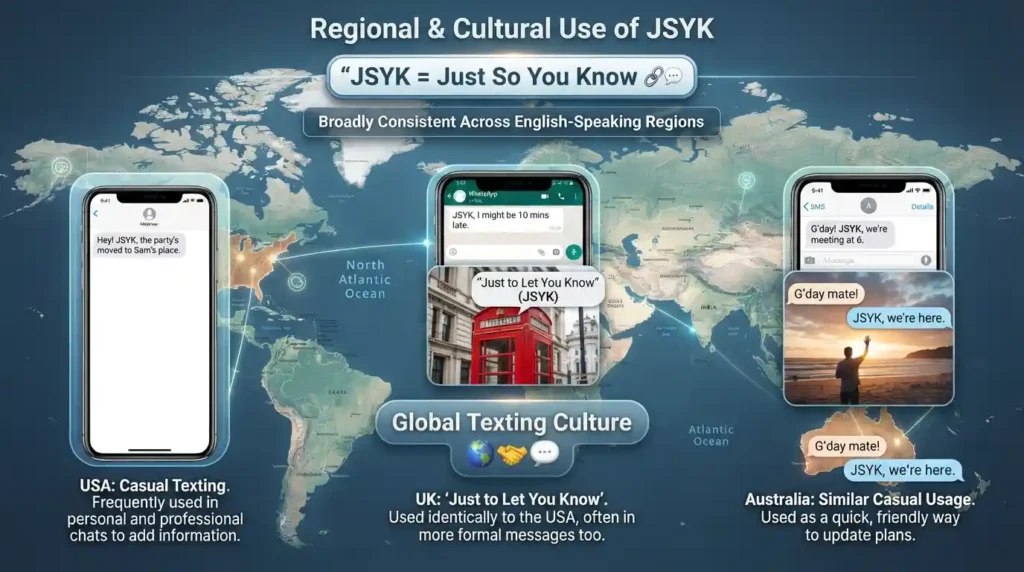
JSYK is widely used across major English-speaking regions, including the USA, UK, and Australia, since it developed primarily through global texting culture rather than regional slang traditions.
In the USA, JSYK is especially common in casual texting among friends and family, often used interchangeably with similar phrases like “heads up” or “FYI.”
In the UK, casual texting culture also uses JSYK, though “just to let you know” or “just so you’re aware” remain common alternatives in everyday speech.
Because it’s based on a simple, widely understood English phrase rather than internet-specific slang, JSYK tends to translate easily and consistently across English-speaking regions.
Comparison with Similar Terms
| Term | Formality | Platform | Risk of Confusion |
| JSYK | Casual | Texting, social media | Low |
| FYI | Casual to formal | Texting, email | Low |
| BTW | Casual | Texting, social media | Low |
| Heads up | Casual to semi-formal | Texting, workplace chat | Low |
The main difference between these terms is tone and formality level. JSYK feels slightly more personal and casual compared to the broader, more versatile FYI, which fits both casual and professional settings.
Usage in Online Communities & Dating Apps
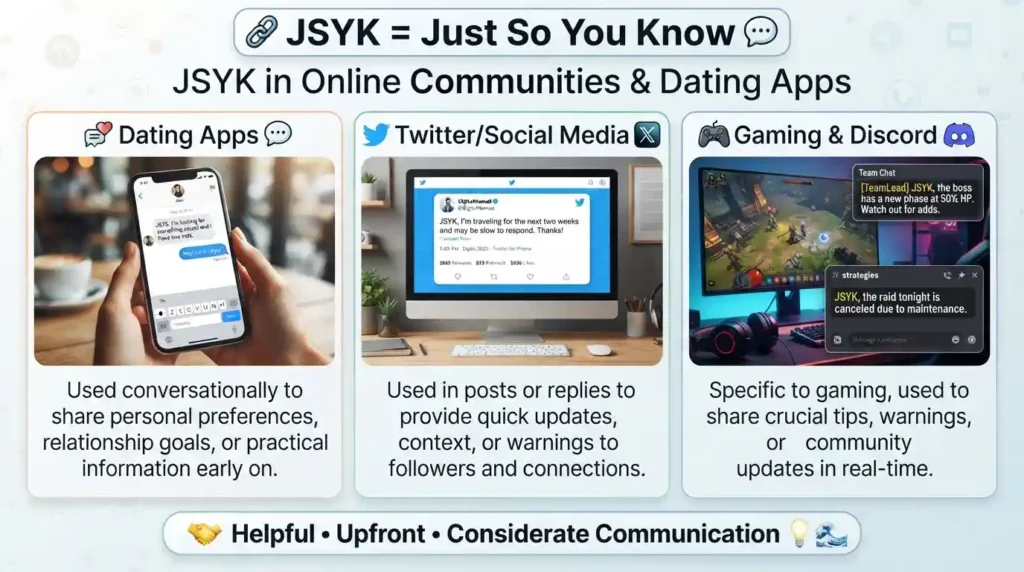
On Tinder or other dating apps, JSYK often appears when sharing personal preferences or practical details early in a conversation.
Match: JSYK, I’m vegetarian, just so you know for restaurant suggestions.
You: Good to know, I actually know a great vegetarian spot nearby.
On Twitter, JSYK frequently appears when sharing quick updates or useful information with followers.
User: JSYK, the event has been moved to a new venue.
In gaming communities, especially Discord, JSYK might pop up when sharing practical gameplay tips or updates.
Teammate: JSYK, that boss has a new attack pattern in this update.
You: Thanks for the warning, I’ll adjust my strategy.
Tip for responding: On dating apps, using JSYK to share preferences or boundaries comes across as considerate and upfront, helping set clear expectations early on.
Hidden or Offensive Meanings
JSYK does not carry any offensive or hidden meaning. It’s a neutral, friendly phrase designed specifically to soften information and make it feel helpful rather than corrective or harsh.
Because its entire purpose is to introduce information gently, there’s little risk of it coming across negatively, as long as the information itself is shared with good intention.
Example:
Friend: JSYK, I noticed you seemed a little off today. Everything okay?
You: Just a long day, but thanks for checking in.
Used this way, JSYK helps open up caring, considerate conversations rather than feeling intrusive.
Suitability for Professional Communication
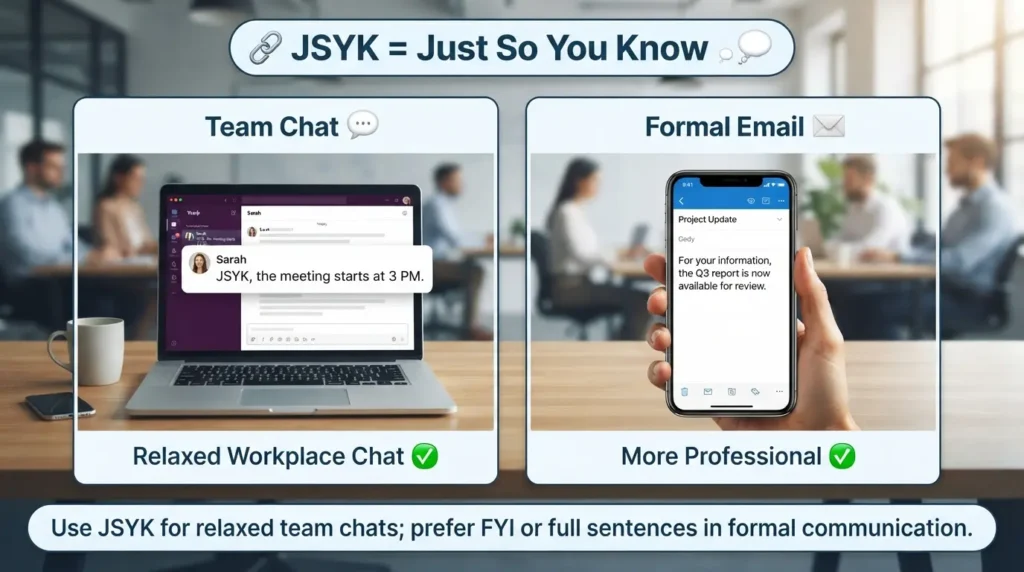
JSYK is somewhat casual for professional communication, though it can work in relaxed workplace chats among close coworkers. For more formal settings, FYI or a full sentence is generally preferred.
Casual but acceptable (team chat): “JSYK, the client call got pushed to 2 PM.”
More formal (email): “For your information, the client call has been rescheduled to 2 PM.”
For formal professional communication, especially with clients or senior colleagues, it’s best to use more traditional phrasing instead of JSYK.
FAQs
1. What does JSYK mean in texting?
It means “Just So You Know,” used to share information casually and helpfully.
2. Is JSYK the same as FYI?
They’re very similar, though JSYK feels more personal and casual, often used between friends.
3. Is JSYK rude to use?
No, it’s generally meant to soften information and make it feel considerate rather than corrective.
4. Can I use JSYK in a work email?
It’s better suited for casual workplace chats. For formal emails, “FYI” or a full sentence works better.
5. Does JSYK always introduce bad news?
No, it’s used for all kinds of information, including helpful tips, reminders, and even compliments.
6. Is JSYK used the same way everywhere?
Yes, it’s understood consistently across major English-speaking countries like the USA, UK, and Australia.
7. Does JSYK have a hidden meaning?
No, it has no hidden or negative meaning. It’s simply a friendly way to introduce helpful information.
Conclusion
JSYK is a simple, friendly way to share information, whether it’s a practical update, a gentle correction, or a helpful heads-up. Its casual tone makes information feel considerate rather than demanding or formal.
Understanding JSYK in text meaning helps you communicate more naturally in everyday texting and social media, whether you’re sharing a quick update with a friend, offering a gentle reminder, or setting expectations early in a new conversation.

Hello,I am Mahrunnisa, a passionate content writer with 2 years of experience in the meaning niche. I love creating simple, clear, and engaging content about words, phrases, expressions, and abbreviations, helping readers understand meanings easily and confidently.