Have you ever seen “RN” in a text and wondered exactly what it meant? You’re not alone. This short, two-letter abbreviation shows up constantly in texting, social media, and casual conversation, usually tucked into a sentence without much fanfare.
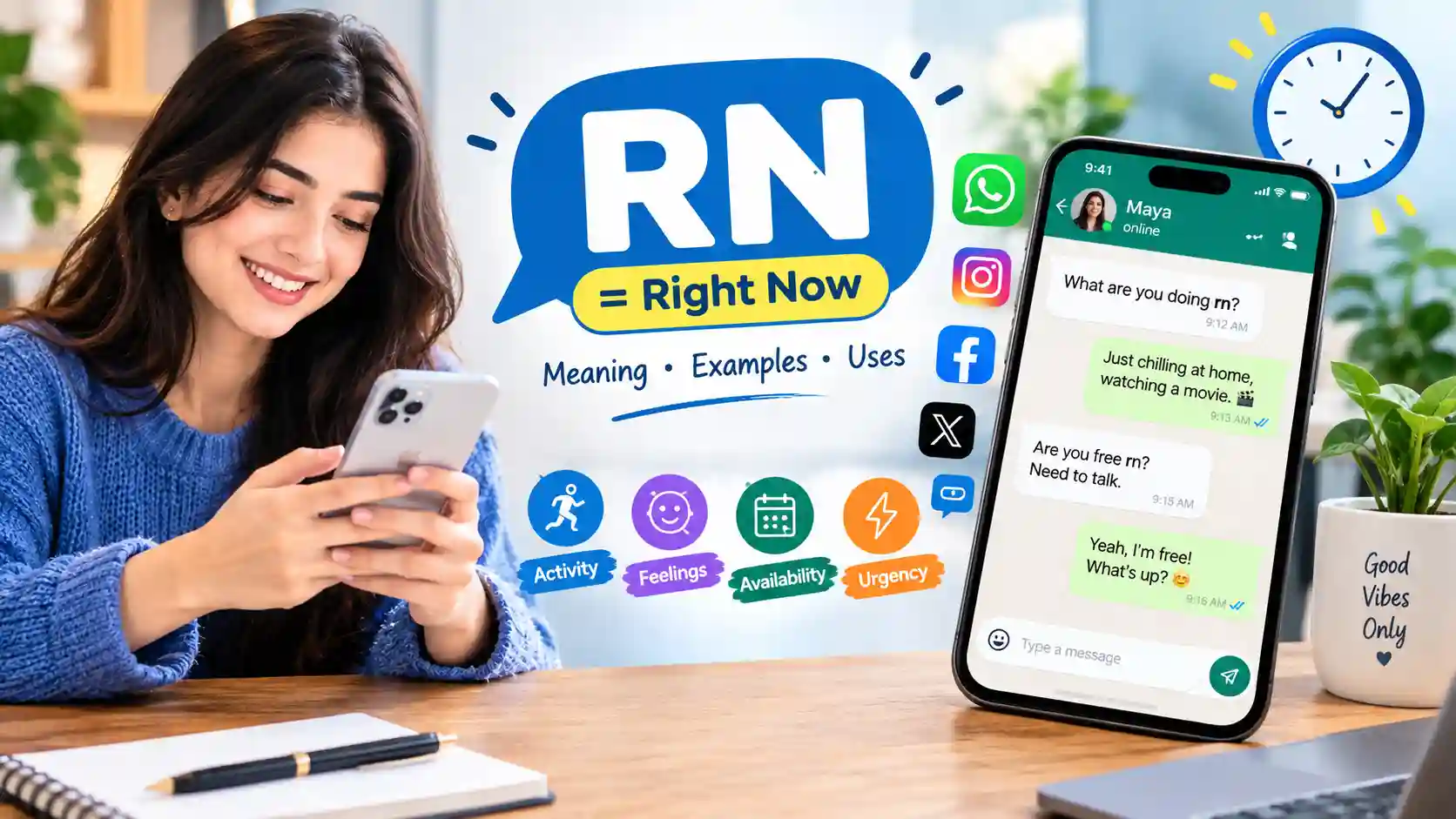
RN stands for “Right Now.” It’s used to emphasize the present moment, whether someone’s describing their current activity, feelings, or availability. You’ll see it in texts, tweets, gaming chats, and everyday casual conversations.
Understanding RN matters because it’s one of those small, frequently used abbreviations that shapes how people communicate urgency, immediacy, or current status in digital conversations. This guide breaks down everything about RN, from its exact meaning to how it’s used naturally across different platforms and situations.
RN in Text Meaning: Definition & Real-Life Examples
RN stands for “Right Now.” It’s used to emphasize the present moment, describing what someone is currently doing, feeling, or experiencing.
Example:
Maya: What are you up to rn?
Jake: Just chilling at home, watching a movie.
It’s commonly used to ask about someone’s current activity or availability.
Example:
Zoe: Are you free rn? Need to talk.
Ben: Yeah, I’m free, what’s up?
RN can also describe current emotional states or situations.
Example:
Sam: I’m so stressed rn, exams are next week.
Ali: I feel that, good luck studying.
RN typically functions as:
- Asking about current status “What are you doing rn?”
- Describing present feelings “I’m exhausted rn”
- Emphasizing immediacy “I need this rn”
Example (emphasizing immediacy):
Friend: Can you help me rn? It’s urgent.
You: On my way!
The core meaning stays simple and consistent: RN emphasizes the present moment, whether describing current activities, feelings, or urgent needs.
The History Behind RN in Text Meaning
RN grew naturally out of general texting culture, following the same pattern as many other abbreviations that shorten common phrases to save time and keystrokes. As mobile texting became widespread in the 2000s, phrases describing the present moment needed quick, efficient shorthand, and “right now” compressed easily into just two letters.
Unlike some slang terms tied to specific cultural moments or platforms, RN developed as a straightforward, functional abbreviation without much cultural baggage or evolving meaning over time. It simply reflects the broader texting habit of abbreviating everyday phrases for speed and convenience.
As texting evolved into social media platforms like Twitter, Instagram, and later Snapchat and TikTok, RN carried over naturally, remaining just as useful for describing current activities, feelings, or status updates in captions and casual posts.
Because RN stands for such a basic, universally understood phrase, its meaning and usage have remained remarkably stable since its earliest use in texting culture, unlike many slang terms that shift or expand in meaning over time.
Today, RN remains common across:
- Casual texting, describing current activities or feelings
- Social media captions and posts, emphasizing the present moment
- Gaming chats, describing current in-game status
- Everyday conversations, both digital and increasingly in casual spoken shorthand among younger speakers
RN in Text Meaning Across Different Platforms
Texting (current activity):
Dan: What are you doing rn?
Ella: Just finished dinner, about to watch TV.
Social Media (describing mood or status):
Caption: Feeling so grateful rn 🙏
Gaming (current status):
Player1: You online rn?
Player2: Yeah, just started a match.
Casual Conversations (urgency):
Noah: I really need advice rn, can we talk?
Ryan: Of course, call me whenever.
Checking Availability:
Coworker1: Are you free rn for a quick call?
Coworker2: Give me five minutes, finishing something up.
This shows how flexible RN is, fitting naturally into questions about activity, mood, availability, and urgency across many casual settings.
Common Misconceptions & Clarifications
Misconception 1: RN always signals urgency.
Not necessarily. While it can emphasize urgency, it’s often used simply to ask about someone’s current activity without any pressing need.
Misconception 2: RN is rude or demanding.
Not inherently. It’s a neutral way to reference the present moment, context and tone determine whether a message feels urgent or casual.
Misconception 3: RN is a recent internet trend.
Not exactly. While it’s commonly used in modern texting, it follows a long-standing pattern of abbreviating common phrases that dates back to early texting culture.
Misconception 4: RN has multiple, unrelated meanings.
Unlike many abbreviations, RN stays fairly consistent, almost always meaning “right now” in casual texting and social media.
Clarification: Context shapes how urgent or casual an RN message feels, “What are you doing rn?” reads casually, while “I need this rn” signals clear urgency.
Similar Terms & Alternatives
| Term | Meaning | Common Use |
| RN | Right now | Casual texting, social media |
| ATM | At the moment | Texting, casual conversation |
| Currently | Formal version of “right now” | Professional writing, formal speech |
| Rn rn | Emphasized version of “right now” | Casual texting |
| TBH | To be honest | Casual texting, often paired with RN |
Example:
Alex: TBH, I’m pretty tired rn.
Jordan: Same, long day for both of us.
These terms often appear together in casual conversations, helping texters quickly describe their current state or situation.
How to Respond to This Term
Casual:
Friend: What are you doing rn?
You: Just relaxing, you?
Funny:
Friend: I’m procrastinating so hard rn lol
You: Relatable, my to-do list is judging me too
Professional:
RN is generally too casual for formal communication, but in relaxed workplace chats:
Coworker: Are you available rn for a quick question?
You: Yes, go ahead.
Privacy-Conscious:
If you’re not comfortable sharing what you’re currently doing:
You: Just busy with something rn, I’ll catch up with you later!
Matching tone keeps the conversation natural, whether it’s a casual check-in or an urgent request.
Regional or Cultural Differences
RN is widely understood across major English-speaking regions, including the USA, UK, and Australia, since it directly shortens a common English phrase rather than relying on regional slang.
In the USA, RN is extremely common in everyday texting and social media, especially among younger texters who frequently abbreviate common phrases.
Because it’s based directly on a simple English phrase rather than internet-specific slang, RN tends to carry a highly consistent meaning across English-speaking regions.
Comparison with Similar Terms
| Term | Formality | Platform | Risk of Confusion |
| RN | Casual | Texting, social media | Low |
| ATM | Casual | Texting, casual conversation | Low |
| Currently | Formal | Professional writing | Low |
| TBH | Casual | Texting, social media | Low |
The main difference between these terms is formality level. RN and ATM work well in casual digital communication, while “currently” fits more formal or professional contexts.
Usage in Online Communities & Dating Apps
On Tinder or other dating apps, RN often appears when discussing current availability or plans.
Match: What are you up to rn?
You: Just relaxing at home, how about you?
On Twitter, RN frequently appears in posts describing current moods, activities, or reactions.
User: So hungry rn, might order food.
In gaming communities, especially Discord, RN commonly describes current availability or in-game status.
Teammate: You free to play rn?
You: Yeah, just logging in now.
Tip for responding: On dating apps, using RN to describe your current activity adds a natural, in-the-moment feel to casual conversation starters.
Hidden or Offensive Meanings
RN does not carry any offensive or hidden meaning. It’s a straightforward, neutral abbreviation describing the present moment, with no coded or secretive connotation behind it.
Because its meaning is so clear and consistent, there’s little risk of it being misread negatively. The only minor consideration is tone, since a blunt “need this rn” in a tense conversation might come across as slightly demanding, even if that wasn’t the intent.
Example:
Friend: Can we talk rn? Kind of a lot going on.
You: Of course, I’m here, what’s up?
Suitability for Professional Communication
RN is generally too casual for formal professional communication, such as official emails or client-facing messages.
Too casual: “Need this file rn.”
Better: “Could you send me this file as soon as possible?”
For professional settings, spell out the full phrase instead:
- Instead of “rn,” use “right now” or “currently”
This keeps communication clear and appropriately professional in formal contexts.
FAQs
1. What does RN mean in texting?
It stands for “Right Now,” used to describe the present moment, current activities, or feelings.
2. Is RN the same as ATM?
They’re very similar, both meaning something close to “right now” or “at the moment,” often used interchangeably in casual texting.
3. Is RN rude to use in texts?
No, it’s a normal, casual way to reference the present moment in everyday conversation.
4. Can I use RN in a work email?
It’s better to avoid it in formal emails. Use “right now” or “currently” instead.
5. Does RN always signal urgency?
Not necessarily. It can simply describe current activities casually, without any pressing urgency.
6. Is RN used outside English-speaking countries?
It’s mostly used where English texting culture is common, including the USA, UK, and Australia.
7. Does RN have a hidden meaning?
No, it has no hidden or offensive meaning. It’s simply short for “right now.”
Conclusion
RN is a simple, widely used abbreviation standing for “Right Now,” commonly used to describe current activities, feelings, or availability. It fits naturally into casual texting, social media, and everyday conversations, though it’s best avoided in formal writing.
Understanding RN in text meaning helps you read casual messages quickly and respond naturally, whether you’re checking in on a friend’s current mood, discussing availability for plans, or simply describing what you’re up to in the moment.

Hello,I am Zarish, a passionate content writer with 2 years of experience in the meaning niche. I create clear, engaging, and easy-to-understand content about words, phrases, slang, abbreviations, and expressions, helping readers understand language with confidence.