Have you ever sent a text, seen the word “Delivered” pop up under it, and wondered exactly what that meant? You’re not alone. This small status label shows up constantly in texting apps, and it carries more meaning than people often realize.
Delivered is a simple but important status indicator used in texting and messaging apps like iMessage, WhatsApp, and Android Messages. It tells you that your message successfully reached the other person’s device, even if they haven’t opened or read it yet.
Understanding “Delivered” matters because it shapes how we interpret silence in conversations. Seeing “Delivered” but no reply can feel confusing or even a little anxiety-inducing. Knowing exactly what this status does and doesn’t tell you helps you read texting situations more accurately, without jumping to the wrong conclusions.
Delivered in Text Meaning: Definition & Real-Life Examples

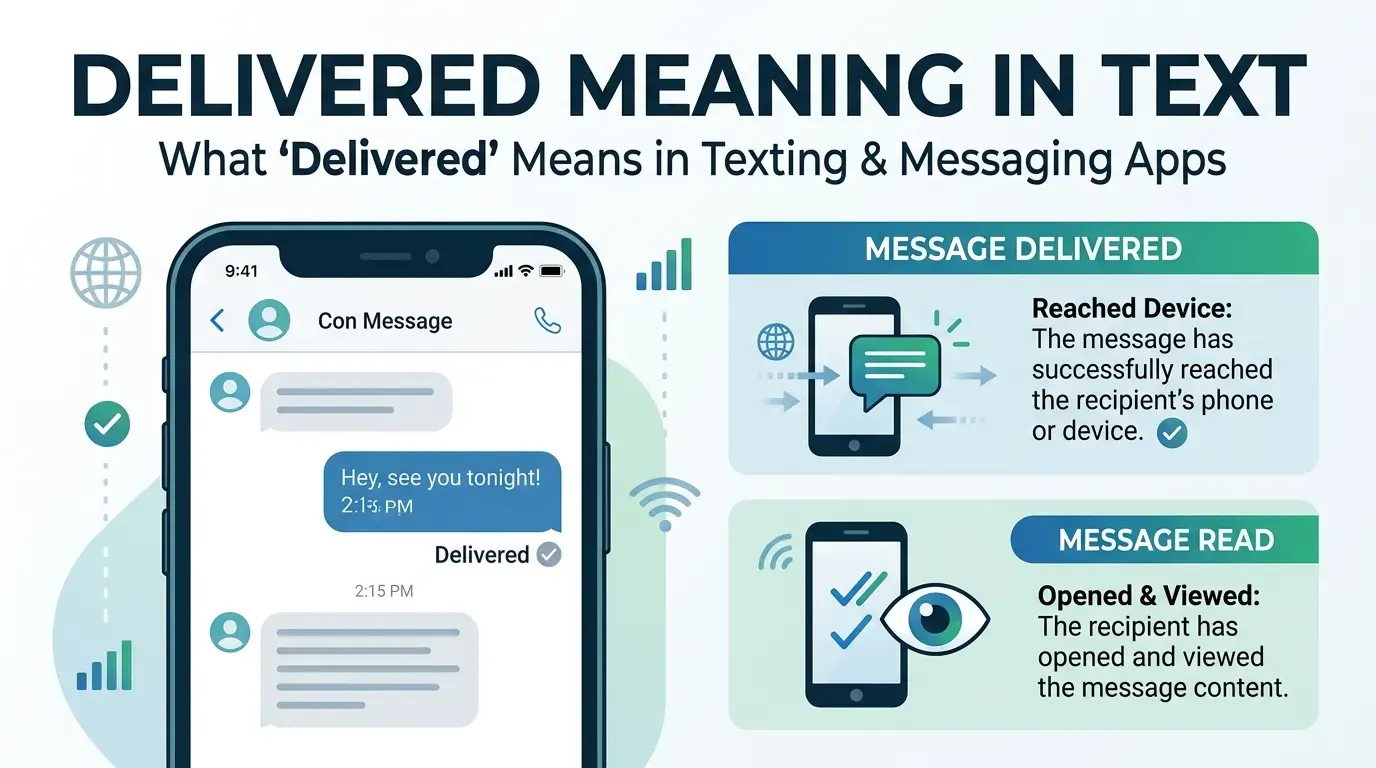
“Delivered” is a status label that appears under a sent text message, confirming that the message successfully reached the recipient’s phone or device. Importantly, it does not mean the person has read it yet, only that it arrived.
Example:
Text sent: “Hey, are we still on for dinner tonight?”
Status shown: Delivered
This means the message reached the recipient’s phone, but they may not have opened it or seen the notification yet.
“Delivered” is different from “Read,” which appears (on apps that support read receipts) once the recipient actually opens and views the message.
Example conversation showing the difference:
You send: “Running 10 minutes late!”
Status: Delivered
Status updates to: Read
Friend replies: “No worries, see you soon!”
On some apps, if a message fails to send due to no signal or an issue with the recipient’s number, it may show as “Not Delivered” or simply fail to update at all, signaling a problem.
Example:
Text sent while in an area with poor signal
Status shown: Not Delivered
(Message automatically resends once signal returns)
The core meaning stays consistent across most platforms: “Delivered” confirms the message reached the device, not that a person has seen or read it.
The History Behind Delivered in Text Meaning
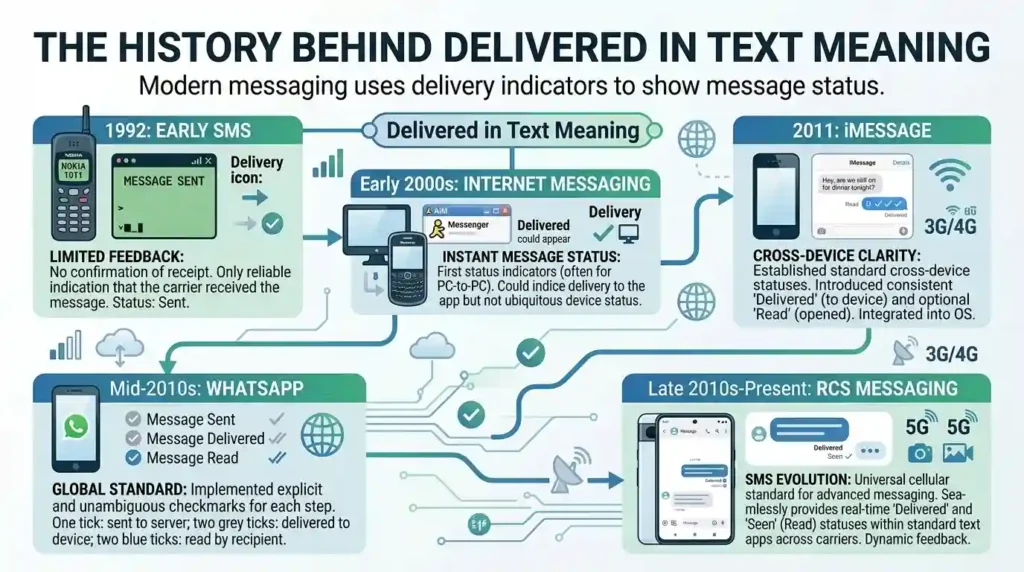
Message status indicators like “Delivered” grew out of the shift from basic SMS texting to smarter, internet-based messaging systems. Early SMS texting, which relied purely on cellular networks, generally didn’t show detailed delivery confirmations to the sender. Messages either sent successfully or failed, with limited detail in between.
As iMessage, WhatsApp, and other internet-based messaging apps emerged in the late 2000s and 2010s, they introduced more detailed status tracking. These apps used internet data rather than relying solely on cellular signals, allowing for real-time confirmation that a message had reached the recipient’s device.
Apple’s iMessage, launched in 2011, became one of the most well-known apps to popularize the “Delivered” and “Read” status system, especially among iPhone users. WhatsApp followed with its own system, using single and double checkmarks to represent sent, delivered, and read statuses.
This shift changed how people communicate. Suddenly, senders could see much more detail about what happened to their message, which added a new layer of social expectation around response times.
Today, “Delivered” status remains standard across most major messaging platforms:
- iMessage (iPhone to iPhone)
- Android Messages (RCS-enabled)
- Facebook Messenger
Its consistent presence across platforms shows how important real-time delivery confirmation has become in everyday digital communication.
Delivered in Text Meaning Across Different Platforms
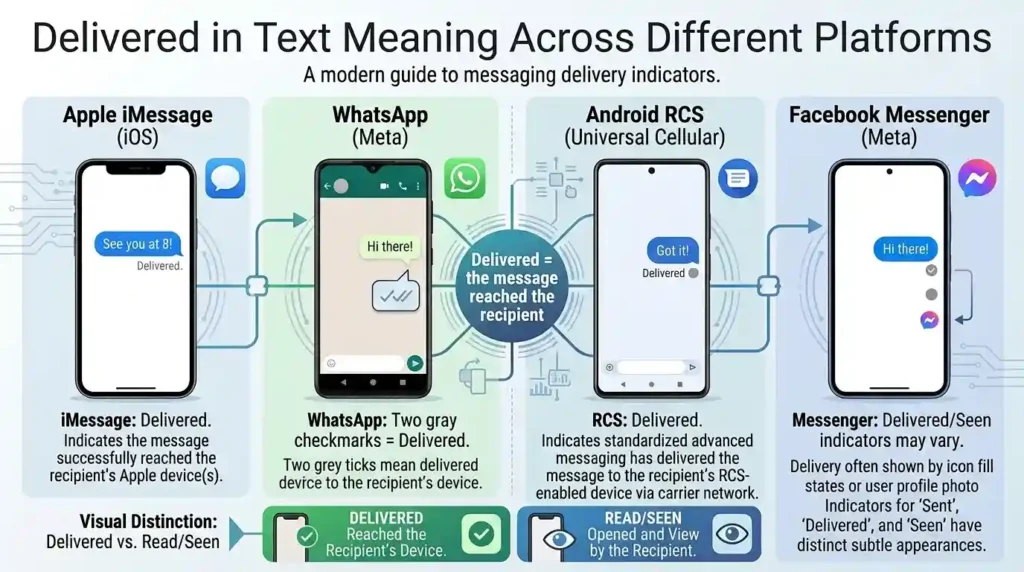
iMessage:
You: “Can you send me that file when you get a chance?”
Status: Delivered
(No read receipt shown, since the recipient may have Read Receipts turned off)
WhatsApp:
You: “Call me when you’re free!”
Status: Two gray checkmarks (Delivered)
(Checkmarks turn blue once the message is Read, if Read Receipts are enabled)
Android Messages (RCS):
You: “Meeting moved to 3 PM.”
Status: Delivered
(Updates to “Read” if the recipient has read receipts enabled)
Group Chats:
You: “Who’s bringing snacks tonight?”
Status: Delivered to all members
(Some apps show individual read status per person in the group)
Business or Customer Service Texts:
Business: “Your order has shipped!”
Status: Delivered
(Confirms the customer received the update, even if not yet opened)
Across these platforms, “Delivered” consistently signals successful message transmission, while “Read” (when available) confirms the message was actually opened.
Common Misconceptions & Clarifications
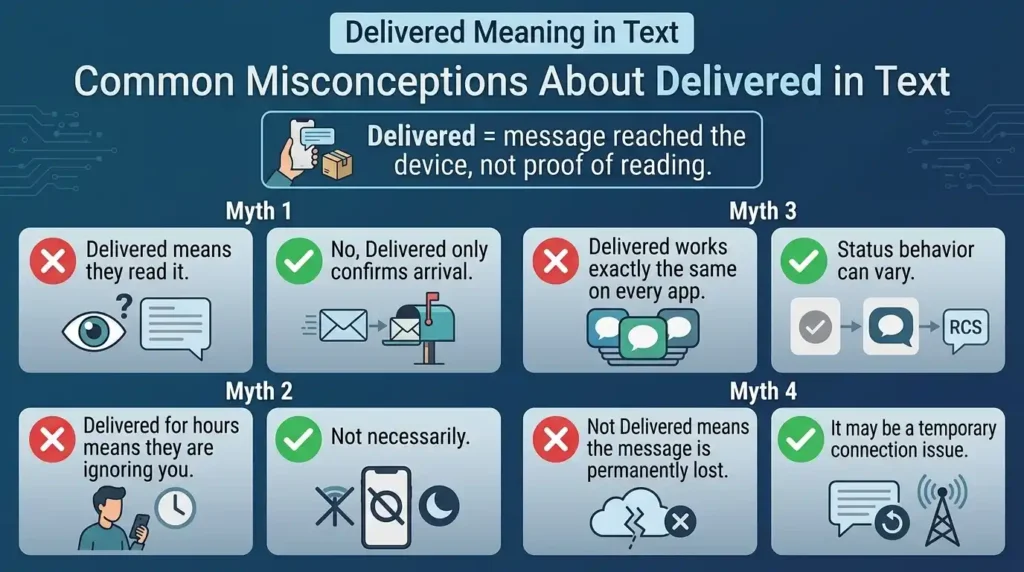
Misconception 1: “Delivered” means the person has read the message.
Not true. “Delivered” only confirms the message reached their device, not that they’ve seen it.
Misconception 2: If a message stays on “Delivered” for hours, the person is ignoring you.
Not necessarily. They may not have checked their phone, or they might have read receipts turned off entirely.
Misconception 3: “Delivered” means the same thing on every app.
While the general concept stays similar, exact behavior can vary. Some apps show delivery status by default, while others require specific settings enabled.
Misconception 4: A message that never shows “Delivered” is always lost.
Sometimes it’s just a temporary signal or connectivity issue, and the message resends automatically once a connection is available.
Clarification: Seeing “Delivered” without a reply doesn’t necessarily mean someone is avoiding you. Many people leave notifications unread for hours due to work, sleep, or simply not checking their phone.
Similar Terms & Alternatives
| Term | Meaning | Common Use |
| Delivered | Message reached the recipient’s device | Most messaging apps |
| Read | Message was opened and viewed | iMessage, WhatsApp, Messenger |
| Sent | Message left your device successfully | General texting |
| Seen | Similar to “Read,” used on some platforms | Facebook Messenger, Instagram |
| Not Delivered | Message failed to reach the recipient | SMS, poor connectivity situations |
Example:
You: “Hope you’re doing okay today.”
Status progression: Sent → Delivered → Seen
These terms often appear together as a message moves through different stages, helping senders understand exactly what’s happening with their text.
How to Respond to This Term
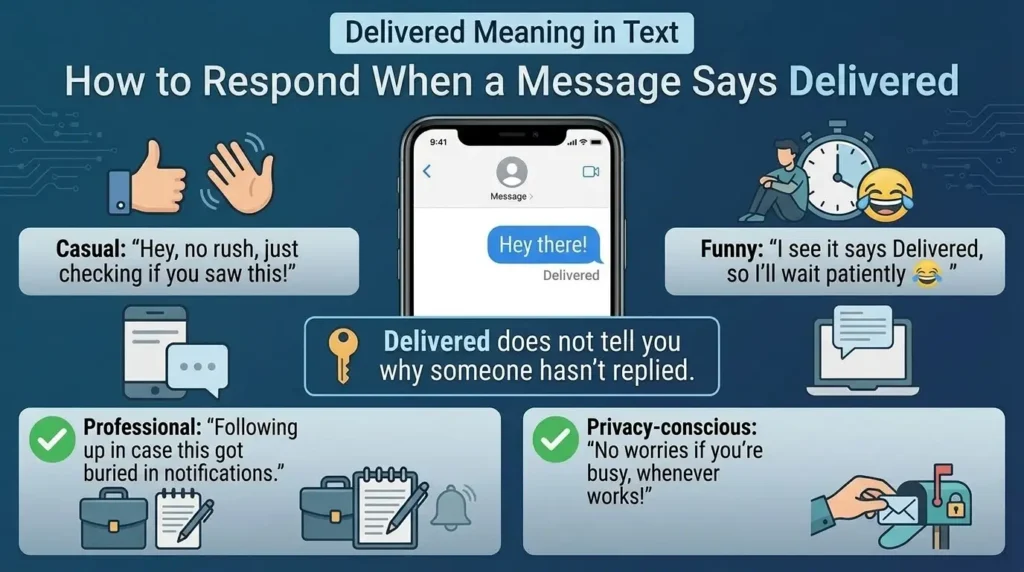
Since “Delivered” isn’t something someone sends you directly, but rather a status you see, “responding” to it really means deciding how to interpret and act on it.
Casual:
If a message has been “Delivered” for a while with no reply:
You (follow-up text): “Hey, no rush, just checking if you saw this!”
Funny:
You: “I see it says ‘Delivered,’ not ‘Ignored,’ so I’ll wait patiently “
Professional:
In work settings, avoid assuming ignorance from delivery status alone:
You: “Following up in case this got buried in notifications let me know when you get a chance.”
Privacy-Conscious:
If you’re waiting on a reply and don’t want to seem pushy:
You: “No worries if you’re busy, whenever works!”
Understanding what “Delivered” actually confirms helps you avoid overreacting to a lack of immediate reply.
Regional or Cultural Differences
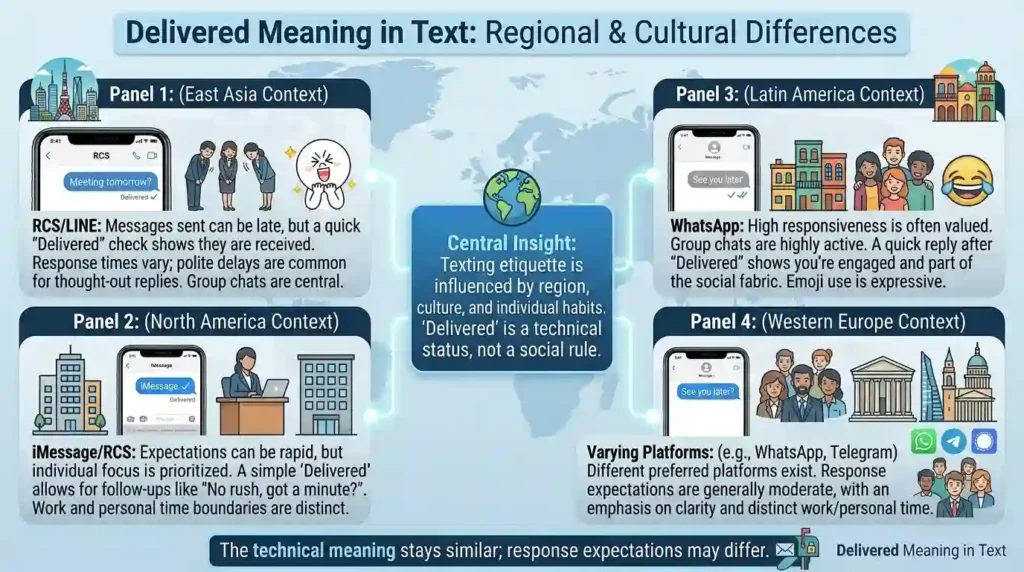
“Delivered” status is a technical feature built into messaging apps, so its meaning stays consistent across English-speaking regions like the USA, UK, and Australia. The term itself doesn’t vary by culture, since it’s tied directly to app functionality rather than slang.
However, texting etiquette and expectations around delivery and read statuses can vary by culture and individual habit. In some social circles, leaving a message on “Delivered” for a long time is considered completely normal, while in others, quick replies are expected as a courtesy.
Globally, apps like WhatsApp dominate messaging in many countries outside the U.S., while iMessage remains more common among iPhone users primarily in the U.S., UK, and Australia. This affects which specific delivery/read system people are most familiar with, even though the underlying concept of “Delivered” remains the same.
Comparison with Similar Terms
| Term | What It Confirms | Platform | Common Misunderstanding |
| Delivered | Message reached the device | Most apps | Confused with “Read” |
| Read/Seen | Message was opened | iMessage, WhatsApp, Messenger | Assumed to mean instant reply is coming |
| Sent | Message left your device | All apps | Rarely confused, simplest status |
| Not Delivered | Message failed to reach the device | SMS, poor signal areas | Assumed to mean permanent failure |
The clearest distinction is between “Delivered” and “Read.” Delivered confirms arrival; Read confirms the recipient actually opened and viewed the message.
Usage in Online Communities & Dating Apps
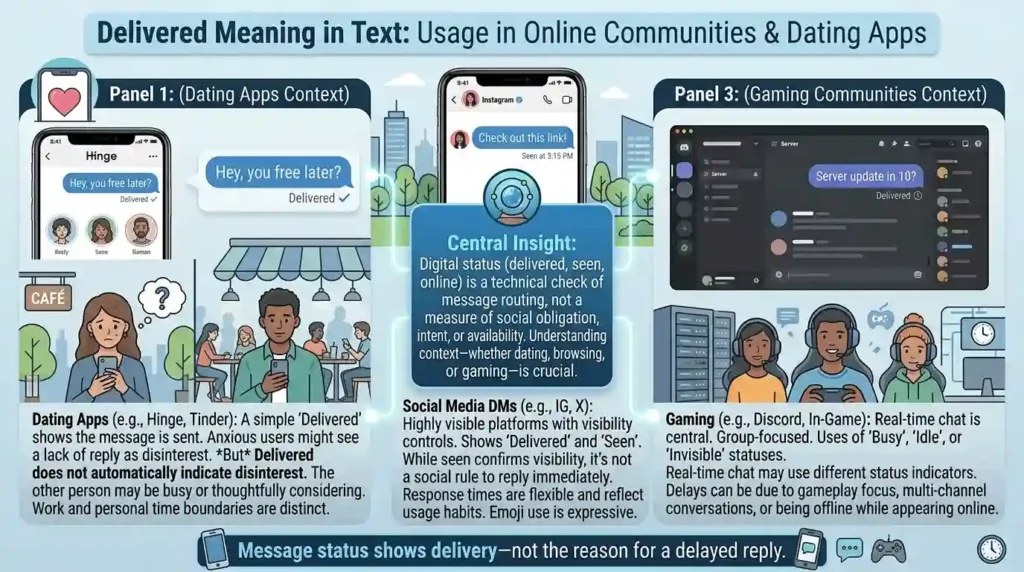
On Tinder and other dating apps, delivery and read statuses can carry extra emotional weight, since people often read into response timing more closely in early conversations.
Match: “Hey, how’s your week going?”
Status: Delivered
(No reply for a few hours)
You (later): “Hope your week’s picking up! No pressure to reply right away.”
On Twitter and other social platforms, direct messages often show similar delivery indicators, though the emphasis is usually less intense than on dating apps.
In gaming communities, especially those using in-app messaging or Discord DMs, delivery status matters less, since most communication happens in real-time chat rather than asynchronous texting.
Tip for responding: On dating apps, avoid assuming disinterest just because a message sits on “Delivered.” People often get busy, and reading too much into status alone can create unnecessary stress.
Hidden or Offensive Meanings
“Delivered” does not carry any offensive or hidden meaning. It is a purely functional, technical status indicator built into messaging apps.
That said, it can carry emotional weight in social situations, especially when someone feels ignored after seeing their message sit as “Delivered” for a long time. This isn’t a hidden meaning within the term itself, but rather a common emotional reaction to unanswered messages.
Example:
Friend: “I texted you an hour ago and it still says Delivered, not Read.”
You: “Sorry, my phone was on silent during a meeting! Just saw it now.”
Understanding that “Delivered” doesn’t reflect a person’s intentions helps prevent unnecessary conflict or hurt feelings over simple timing.
Suitability for Professional Communication
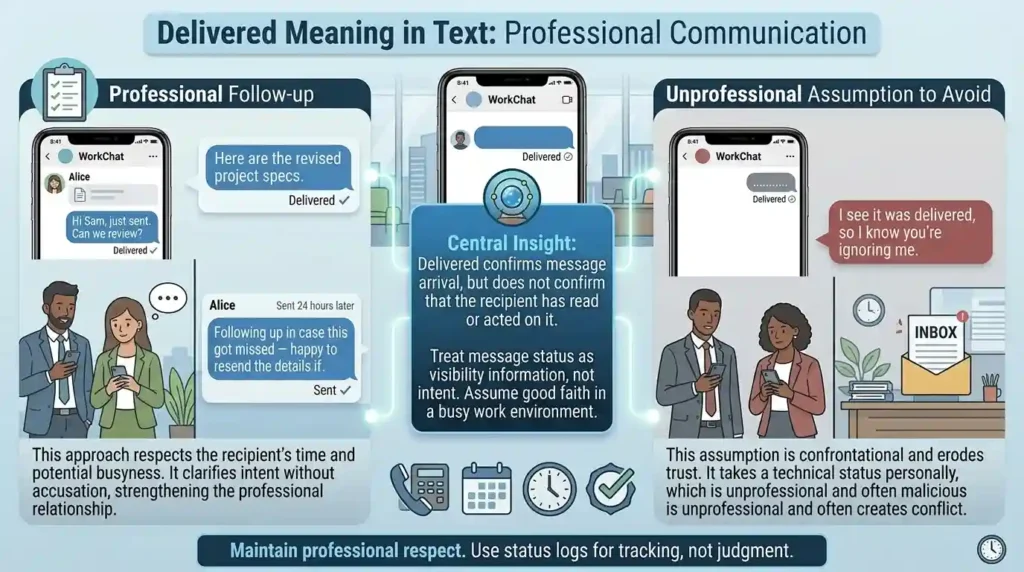
“Delivered” status is completely appropriate in professional communication, since it’s a built-in technical feature rather than slang. However, how you respond to delivery status in a professional context matters.
Appropriate professional follow-up:
“Just wanted to confirm you received my last message about the meeting time let me know if you have any questions.”
Avoid assuming negative intent based on status alone:
Instead of: “I see it was delivered, so I know you’re ignoring me.”
Use: “Following up in case this got missed happy to resend the details if needed.”
In professional settings, it’s best to focus on clear follow-ups rather than reading too much into delivery or read status.
FAQs
1. What does “Delivered” mean in texting?
It means your message successfully reached the recipient’s device, though they haven’t necessarily read it yet.
2. Is “Delivered” the same as “Read”?
No, “Read” confirms the recipient actually opened and viewed the message, while “Delivered” only confirms arrival.
3. Why does a message stay on “Delivered” for a long time?
The recipient likely hasn’t checked their phone or opened the message yet, or they may have read receipts turned off.
4. Does “Not Delivered” mean the message is lost forever?
Not necessarily. It often means a temporary connectivity issue, and many apps automatically resend once a connection is available.
5. Can I turn off “Delivered” status on my phone?
Delivery confirmation itself is usually a built-in network feature, though read receipts (a separate setting) can often be turned off in app settings.
6. Does “Delivered” mean the same thing on every app?
The general concept is similar, though exact behavior and available settings can vary between apps like iMessage, WhatsApp, and Android Messages.
7. Should I worry if someone hasn’t replied but the message shows “Delivered”?
Not necessarily. Many people leave messages unread for hours due to daily life, so it’s usually best not to assume anything negative.
Conclusion
“Delivered” is a simple but important text status confirming that your message successfully reached the recipient’s device, though it doesn’t guarantee they’ve seen or read it yet. Understanding the difference between “Delivered” and “Read” helps prevent unnecessary worry or misunderstandings in everyday texting.
Whether you’re waiting on a reply from a friend, a match on a dating app, or a colleague at work, knowing what “Delivered” truly means helps you interpret silence more accurately and respond thoughtfully, without jumping to conclusions based on a simple status update.

Hello,I am Mahrunnisa, a passionate content writer with 2 years of experience in the meaning niche. I love creating simple, clear, and engaging content about words, phrases, expressions, and abbreviations, helping readers understand meanings easily and confidently.