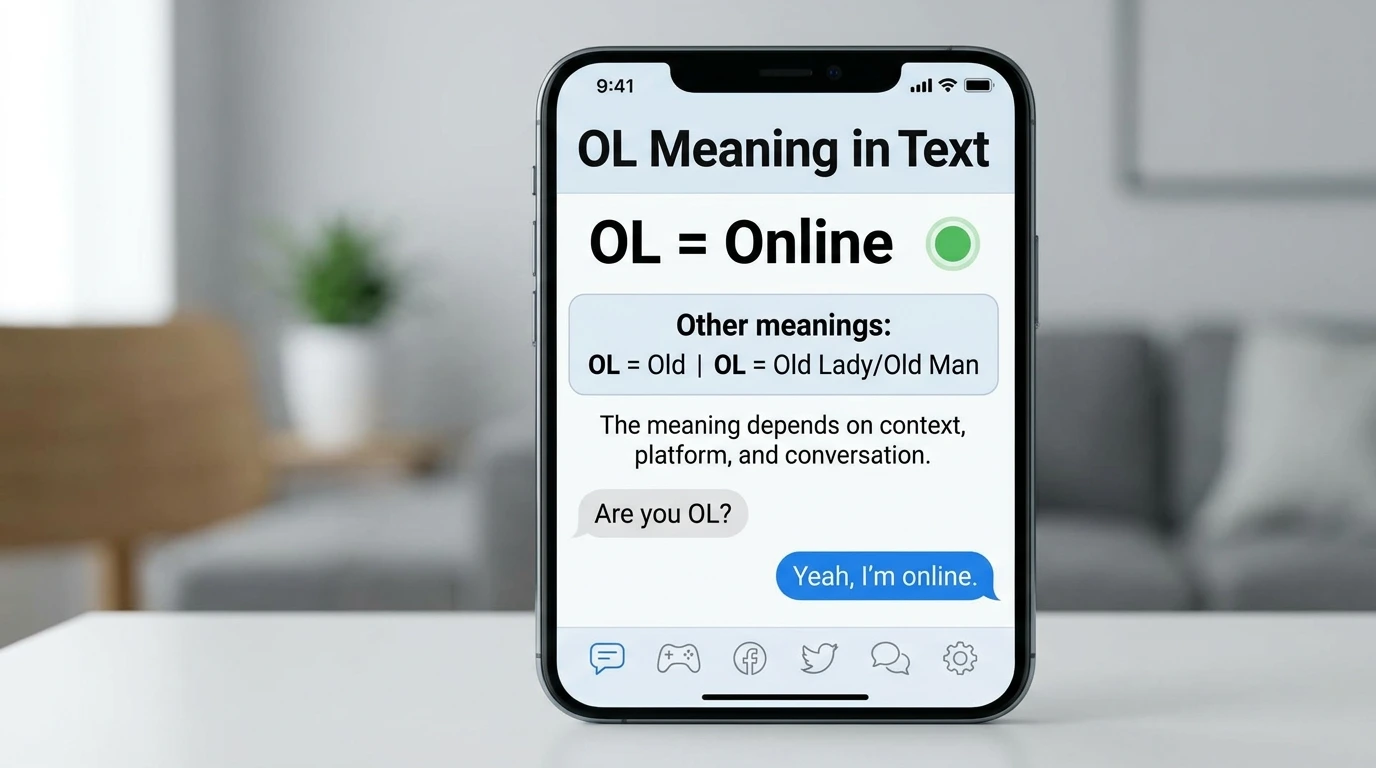
Have you ever seen “OL” in a text and wondered what it means? You’re not alone. Short forms like this show up everywhere in modern chats, and they can confuse anyone seeing them for the first time.
OL is a small term with more than one meaning. It shows up in texting, gaming, social media, and casual talk. Sometimes it’s about being “online.” Other times, it’s short for “old,” used in a casual or affectionate way.
This guide breaks down everything about OL. You’ll learn what it means, where it comes from, and how people use it in different situations. You’ll also learn when it fits and when it might confuse people. By the end, you’ll never wonder about “OL” again.
OL in Text Meaning: Definition & Real-Life Examples

OL most commonly stands for “online.” People use it to say they’re active on a chat app, game, or website.
Example:
Maya: Are you OL right now?
Jake: Yh, just got on.
OL can also be a casual short form of “old,” especially in phrases like “ol’ buddy” or “ol’ pal,” where it adds a warm, informal tone.
Example:
Dan: Hey, my ol’ friend! Long time no talk.
Sam: Ha, feels like forever!
In some casual and older slang, “OL” also appears as short for “old lady” or “old man,” used informally to refer to a spouse or partner. This usage is more common in older internet slang and certain regional or biker communities.
Example:
Rick: Can’t make it tonight, my OL wants me home early.
So the meaning of OL shifts based on context:
- Online — most common in texting and gaming
- Old — casual, affectionate short form
- Old lady/man — informal term for a partner, used mainly in certain communities
Knowing the setting helps you figure out which meaning fits.
The History Behind OL in Text Meaning
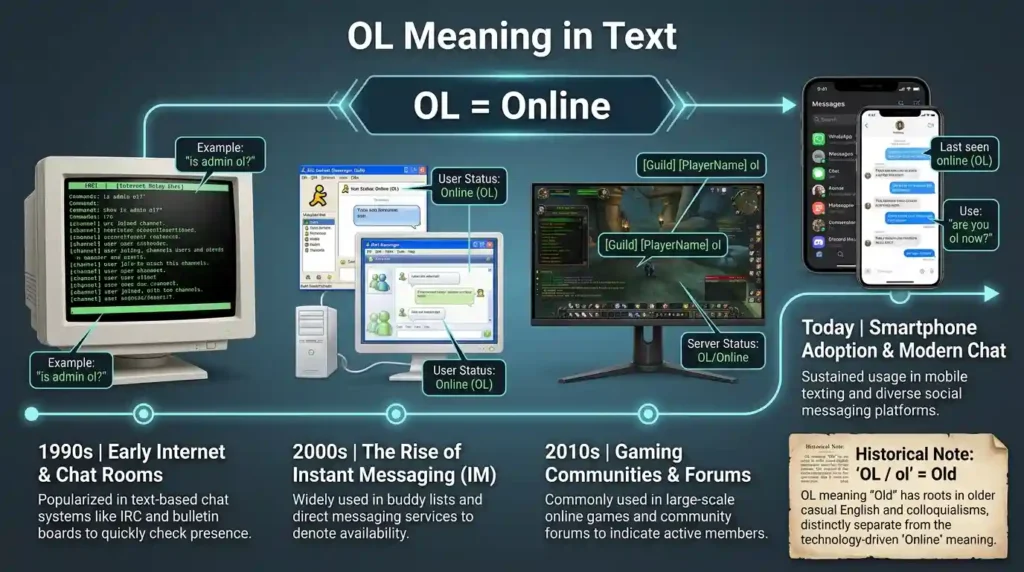
The word “online” became essential once home internet use grew in the 1990s. As people spent more time in chat rooms and instant messengers, they needed a fast way to say they were connected. “OL” became a natural shorthand, especially in gaming communities and early chat platforms.
Gaming culture pushed this even further. Multiplayer games needed quick status updates. Typing “OL” was faster than typing “I’m online” during a fast match.
The “old” meaning of OL has a different root. Shortening “old” to “ol'” has existed in casual English speech for a long time, long before texting existed. People simply carried that spoken habit into typed conversations. It kept a warm, familiar tone, especially in phrases like “ol’ pal” or “ol’ buddy.”
The “old lady/old man” meaning grew from informal slang used across the U.S. Over decades, this phrase became common in casual conversation, especially in specific groups like motorcycle communities, though it also appears more broadly in casual banter.
Today, OL lives across many spaces:
- Gaming chats, where it usually means “online”
- Texting, where it can mean “online” or “old” depending on the sentence
- Casual conversations, where “ol'” adds warmth or humor
OL in Text Meaning Across Different Platforms
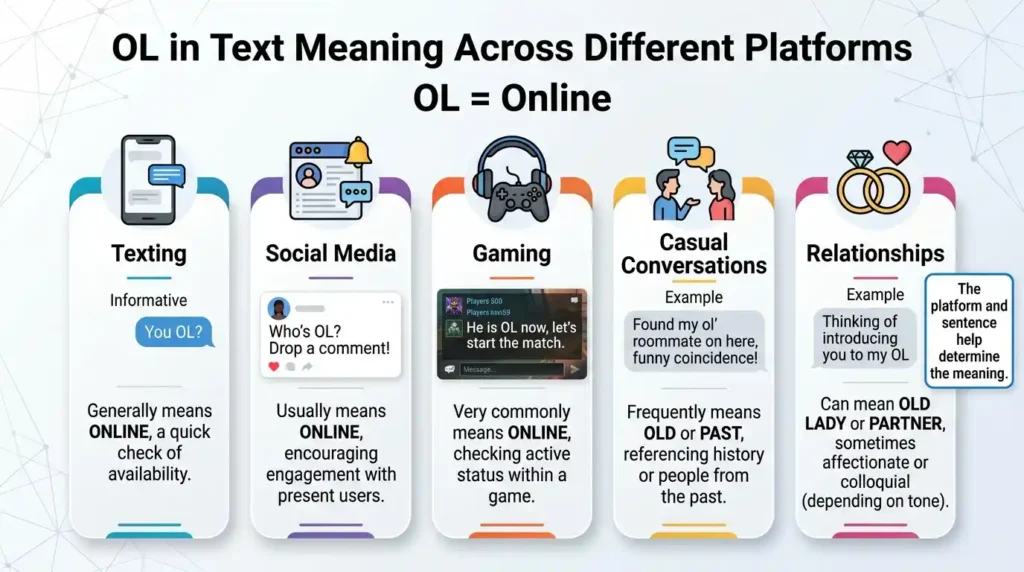
Texting:
Zoe: You OL? Wanna chat?
Ben: Yeah, free now.
Social Media:
User1: Anyone OL to help me with this game glitch?
User2: I’m on, what’s up?
Gaming:
Player1: Who’s OL for a quick match?
Player2: I’m in.
Casual Conversations (using “old” meaning):
Alex: Ran into my ol’ roommate today.
Jordan: No way, how’s he doing?
Informal Relationship Talk:
Tom: Gotta check with my OL before I commit to plans.
Each platform shapes which meaning fits best. Gaming and texting usually lean toward “online,” while casual chats sometimes use the “old” or partner-related meaning.
Common Misconceptions About OL in Text Meaning
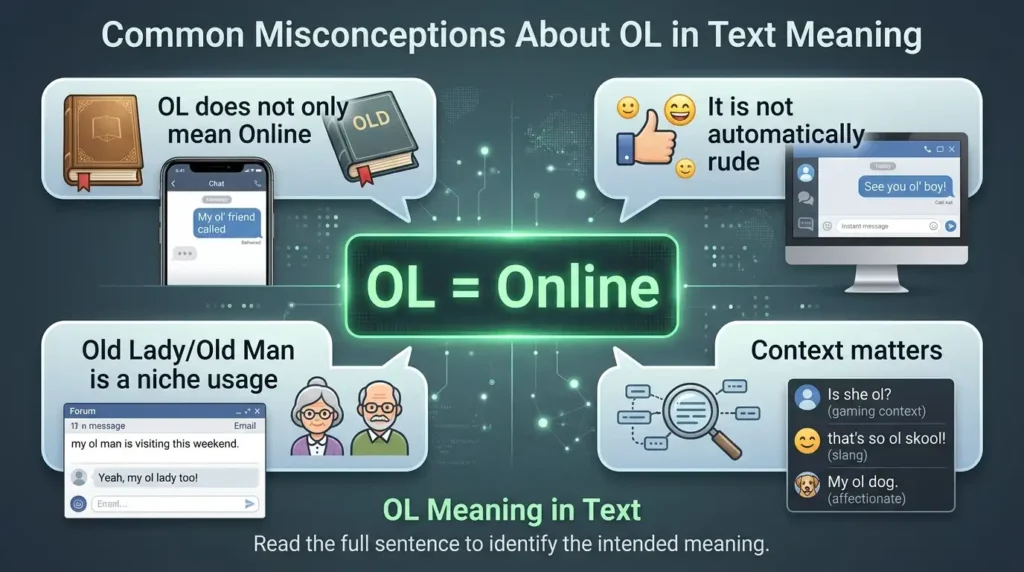
Misconception 1: OL only means “online.”
Not true. Depending on context, it can mean “old” or even refer to a partner.
Misconception 2: OL is rude or disrespectful.
Not inherently. In “ol’ buddy” or “ol’ pal,” it’s affectionate, not negative.
Misconception 3: “OL” as “old lady/man” is universally used.
This meaning is more niche and regional. Many people have never seen this usage and default to “online” instead.
Misconception 4: OL always needs a question mark.
Not necessarily. “You OL?” and “I’m OL” both work naturally without extra punctuation.
Clarification: Context and audience matter. In a gaming server, OL almost always means “online.” In a casual conversation between older friends, it might mean “old.” Reading the full sentence usually clears up the meaning fast.
Terms Similar to OL in Text Meaning
| Term | Meaning | Common Use |
| OL | Online / Old | Texting, gaming, casual talk |
| AFK | Away From Keyboard | Gaming, stepping away briefly |
| BRB | Be Right Back | Texting, gaming |
| ONL | Online (less common variant) | Occasional texting use |
| Ol’ | Old (spoken-style spelling) | Casual, affectionate phrasing |
Example:
Chris: You AFK or OL?
Nina: OL now, just got back.
These terms all help people communicate quickly about their online status or add a casual tone to conversation.
How to Respond When Someone Uses OL in Text
Casual:
Friend: You OL?
You: Yep, what’s up?
Funny:
Friend: My OL is making me clean the garage lol
You: Sounds like a Saturday well spent
Professional:
If a coworker casually asks if you’re online:
Coworker: You OL? Need a quick answer.
You: Yes, I’m available now.
Privacy-Conscious:
If unsure why someone’s asking your online status:
You: I’m around, what do you need?
Matching tone keeps chats natural, whether it’s a quick gaming check-in or a casual catch-up.
Regional Differences in OL in Text Meaning
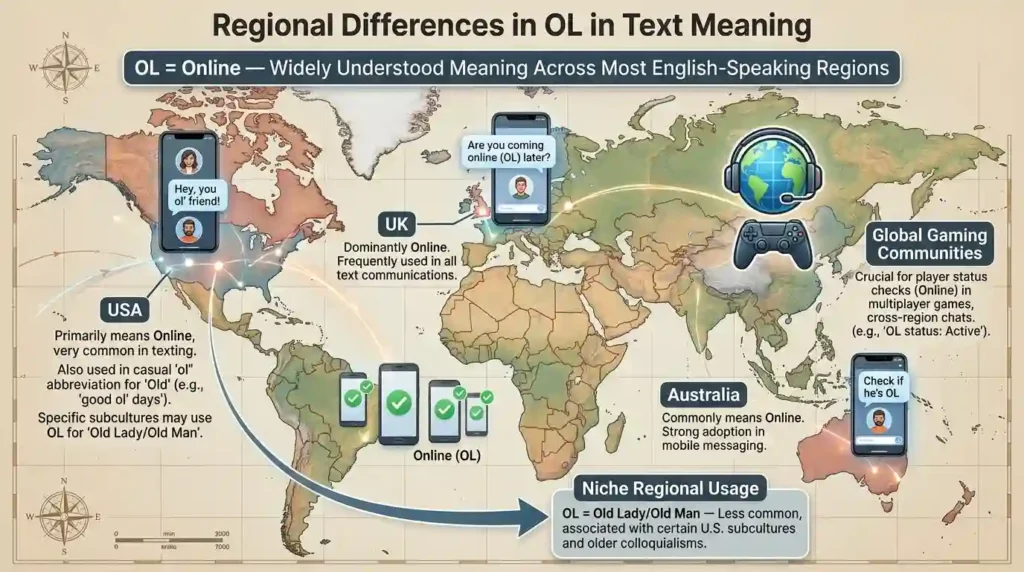
OL meaning “online” is widely understood across the USA, UK, and Australia, especially in gaming and texting culture.
The “old lady/old man” meaning is more common in specific U.S. subcultures, including motorcycle and trucking communities, where it’s used informally to refer to a spouse or partner.
The “ol'” meaning (short for “old”) is common across English-speaking countries in casual speech, especially in the U.S. and parts of the UK, often used affectionately.
In gaming spaces worldwide, OL for “online” is understood broadly, since gaming terms often cross language and cultural lines easily.
OL in Text Meaning vs Other Chat Abbreviations
| Term | Formality | Platform | Risk of Confusion |
| OL | Casual | Texting, gaming | Medium (multiple meanings) |
| AFK | Casual | Gaming | Low |
| BRB | Casual | Texting, gaming | Low |
| Ol’ | Very casual | Casual speech-style texting | Low |
The biggest difference is that OL carries more than one common meaning, so context matters more here than with most similar terms.
OL in Text Meaning on Social Media & Dating Apps
On Tinder or other dating apps, OL usually refers to being online or active.
Match: You OL a lot on here?
You: Mostly evenings after work.
On Twitter, OL rarely appears directly, but similar terms like “online now” or emoji indicators are more common.
In gaming communities, especially Discord servers, OL almost always means “online,” used to check who’s available to play.
Teammate: Who’s OL for ranked?
You: I’m on, let’s queue up.
Tip for responding: On dating apps or social platforms, if “OL” seems unclear, a quick reply like “Yeah, I’m on now” clears up any confusion instantly.
Does OL in Text Meaning Have a Hidden Meaning
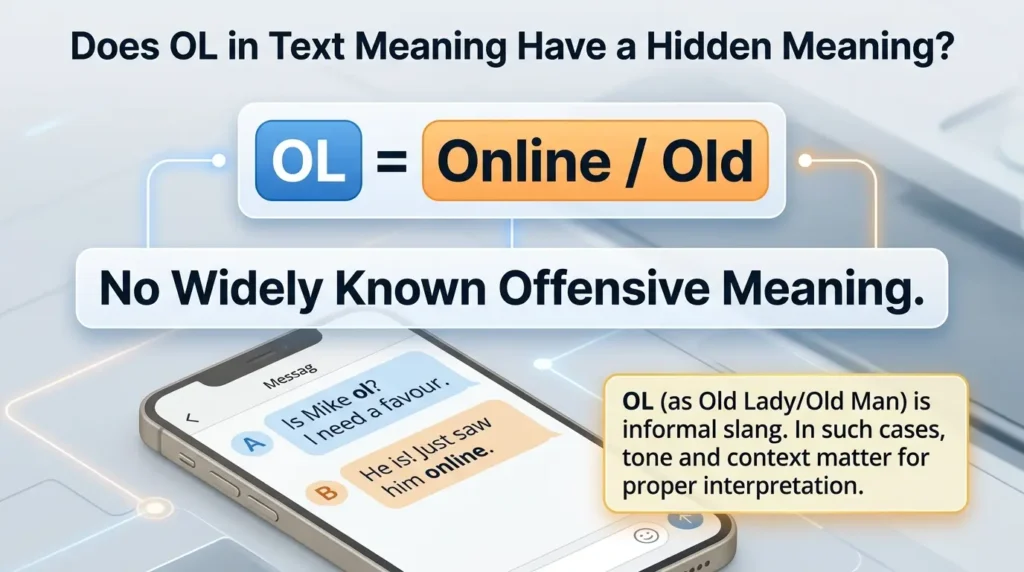
OL does not carry any widely known offensive meaning. It’s mostly a neutral, functional term tied to being online or describing someone as old in a friendly way.
The “old lady/old man” usage, while informal, isn’t inherently offensive, but tone matters. Used affectionately among friends or partners, it feels casual. Used dismissively, it could come across as impersonal.
Example:
Friend: Can’t hang out, gotta check with my OL first.
You: Ha, no worries, hope she says yes!
Tip: If you’re unsure how someone means “OL,” asking directly is always a safe, simple option.
Is OL in Text Meaning Okay for Professional Use
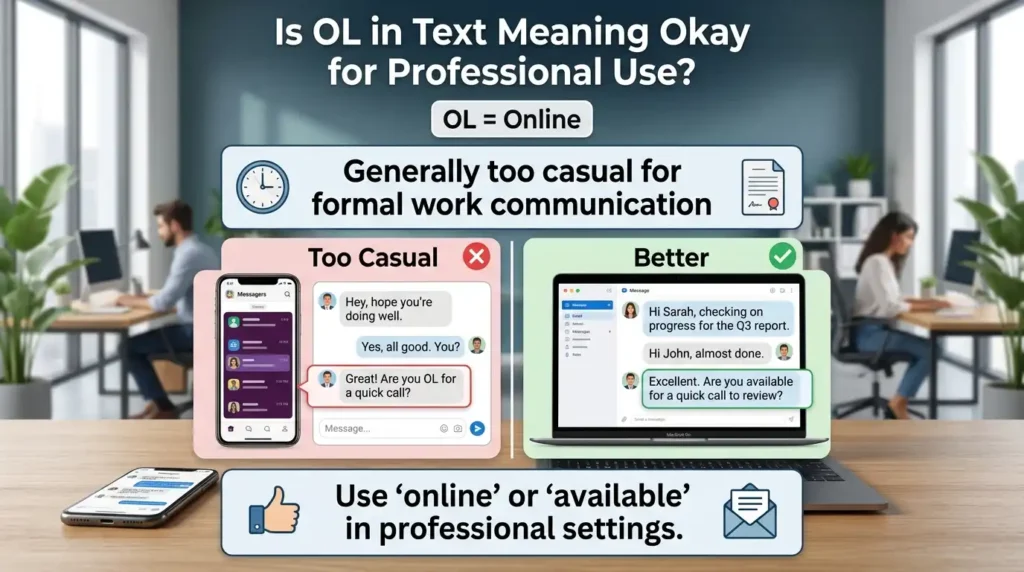
OL is generally too casual for formal work communication. In professional emails or client messages, spell things out fully.
Too casual: “Are you OL for a quick call?”
Better: “Are you available for a quick call?”
For workplace chats, especially with people you don’t know well, avoid slang meanings tied to relationships (like “old lady/man”) entirely, since they can seem unprofessional or unclear.
Use “online” or “available” instead of “OL” in professional settings.
FAQs
1. What does OL mean in texting?
Most often, it means “online,” though it can also mean “old” depending on context.
2. Is OL the same as “online”?
In most texting and gaming contexts, yes.
3. What does OL mean in gaming?
It almost always means “online” in gaming chats.
4. Can OL mean something about a relationship?
Yes, in some informal slang, “OL” can mean “old lady” or “old man,” referring to a spouse or partner.
5. Is OL appropriate for work chats?
It’s best avoided in formal communication. Use “online” or “available” instead.
6. Does OL have an offensive meaning?
No, it’s generally neutral, though tone can shape how it feels in context.
7. Is OL used the same way everywhere?
Mostly, especially for “online,” though the “old lady/man” meaning is more regional and less universally used.
Conclusion
OL is a flexible term that mostly means “online,” though it can also mean “old” or, in some slang, refer to a spouse or partner. Its meaning depends heavily on the platform and the conversation’s tone.
Understanding OL in text meaning helps you read casual messages accurately and respond naturally, whether you’re gaming, texting a friend, or chatting casually online.

Hello,I am Zarish, a passionate content writer with 2 years of experience in the meaning niche. I create clear, engaging, and easy-to-understand content about words, phrases, slang, abbreviations, and expressions, helping readers understand language with confidence.