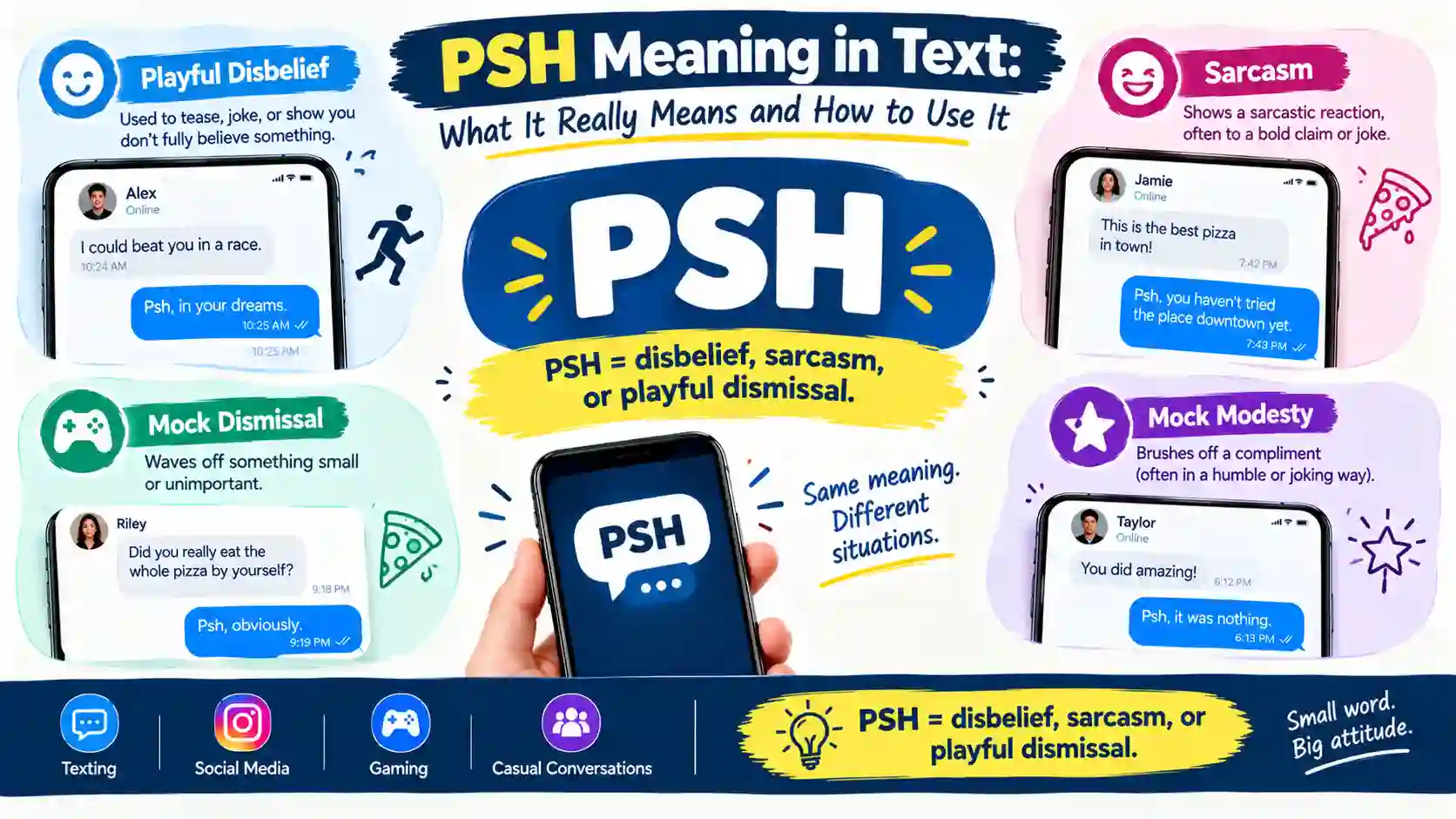
Have you ever texted a friend something you were genuinely excited about, only to get “psh” back? You may have felt confused, or even a little hurt. You’re not alone. This small string of letters carries a lot of tone, and reading it wrong can throw off a whole conversation.
Psh is a common texting expression used to show disbelief, sarcasm, or playful dismissal. It shows up constantly in texting, social media comments, and casual gaming banter.
Understanding psh matters because tone is easy to misread in text. Knowing what it usually means, and what it doesn’t, helps you avoid unnecessary misunderstandings with friends, especially since this tiny word can feel very different depending on the conversation. This guide breaks down everything about psh, from its meaning to how to respond when someone sends it your way.
PSH in Text Meaning: Definition & Real-Life Examples
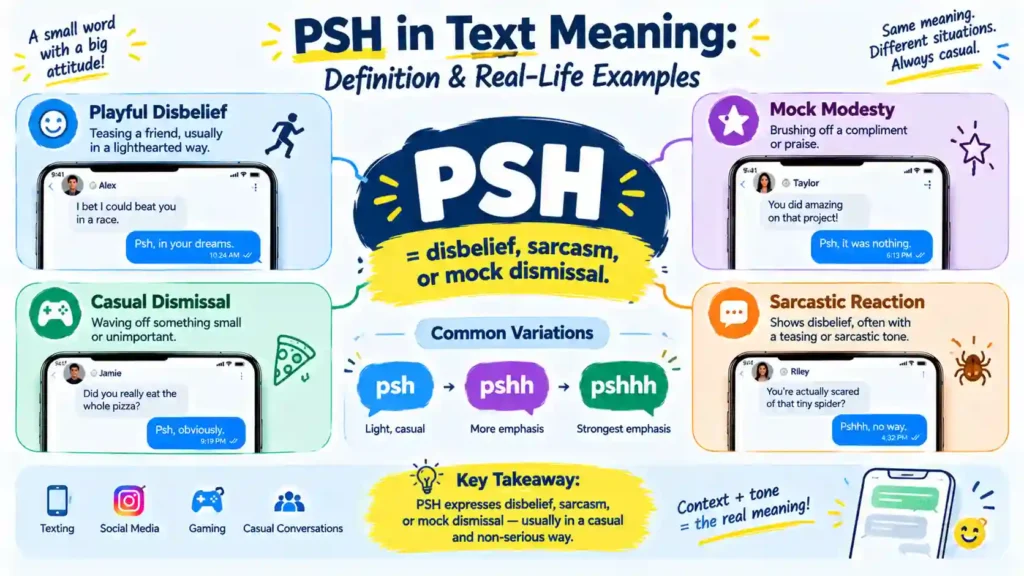
Psh is a written version of a sound people naturally make with their mouths, similar to a puff of air through the lips. It’s used to express disbelief, sarcasm, or mock dismissal, similar to saying “yeah, right” or “oh, please” out loud.
Example:
Liam: I bet I could beat you in a race right now.
Zoe: Psh, in your dreams.
It often shows up as a lighthearted way to brush something off, not necessarily out of real annoyance.
Example:
Sam: Did you really eat the whole pizza by yourself?
Ali: Psh, obviously.
Sometimes people stretch it out for extra emphasis, like “pshh” or “pshhh.”
Example:
Maya: You’re actually scared of that tiny spider?
Jay: Pshhh, no way, I just didn’t want it near my food.
Psh can carry a few related tones depending on context:
- Playful disbelief teasing a friend
- Mock modesty brushing off a compliment
- Casual dismissal waving off something small or unimportant
Example (mock modesty):
Friend: You did amazing in that presentation!
You: Psh, it was nothing.
The core feeling stays the same: psh expresses a small, expressive puff of disbelief or dismissiveness, almost always in a casual, non-serious way.
The History Behind PSH in Text Meaning

Psh comes from a much older verbal expression. Long before texting existed, people made a similar sound out loud to express disbelief or mild contempt, often written in older texts as “pshaw.” This spoken interjection has been used in English for centuries as a way to dismiss something without needing full words.
As texting and instant messaging grew in the 1990s and 2000s, people began looking for ways to represent spoken sounds and reactions in writing. Psh became a natural fit, capturing that same puff-of-air sound in just three or four letters.
Because it directly imitates a sound rather than standing for specific words, psh falls into a small but important category of texting slang called onomatopoeia words that represent sounds rather than abbreviations of phrases. This makes it different from most texting shorthand, which usually shortens full sentences or common words.
As texting culture spread into social media comments, group chats, and casual online banter, psh kept its meaning fairly consistent. It became especially popular among younger texters looking for quick, expressive ways to react without typing out full sentences.
Today, psh remains common across:
- Texting between friends, especially in teasing or joking exchanges
- Social media comments, reacting to posts or claims
- Casual gaming chats, brushing off a joke or minor trash talk
Its long verbal history helps explain why it feels so natural in casual writing, even though it doesn’t stand for any specific words.
PSH in Text Meaning Across Different Platforms
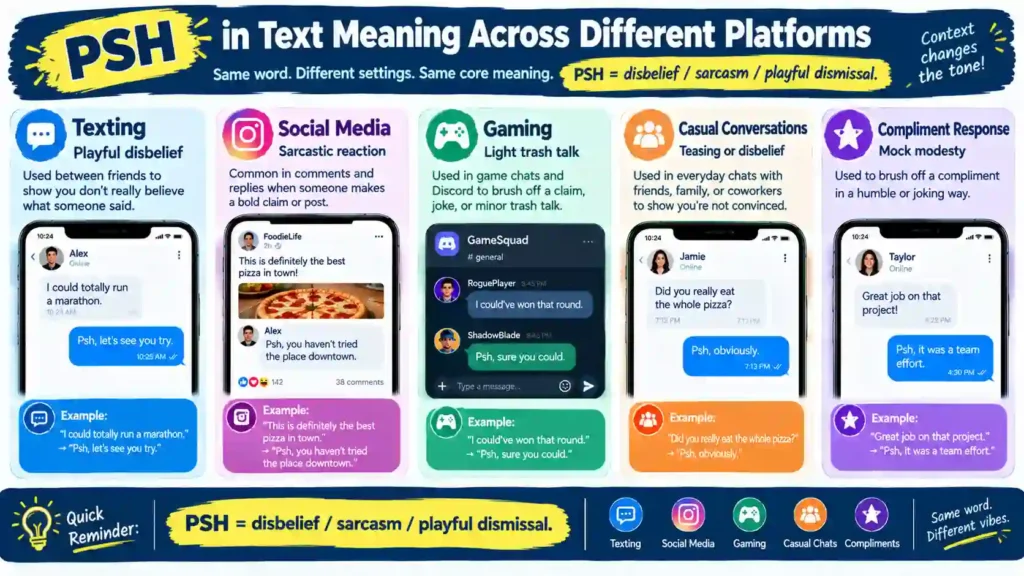
Texting:
Dan: I could totally run a marathon right now.
Ella: Psh, let’s see you try.
Social Media:
User1: This is definitely the best pizza in town.
User2: Psh, you haven’t tried the place downtown yet.
Gaming:
Player1: I could’ve won that round easily.
Player2: Psh, sure you could.
Casual Conversations:
Noah: I think I aced that test.
Ryan: Psh, of course you did, you always do.
Reacting to a Compliment:
Coworker1: Great job on that project.
Coworker2: Psh, it was a team effort really.
This shows how flexible psh is, fitting naturally into teasing, disbelief, or mock-modest reactions across many casual settings.
Common Misconceptions & Clarifications
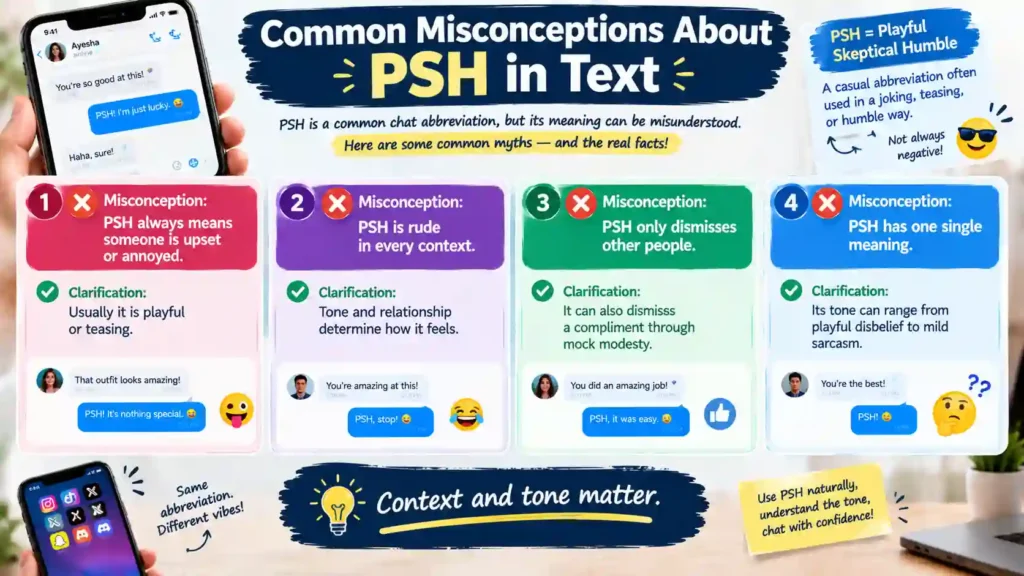
Misconception 1: Psh always means someone is upset or annoyed.
Not true. Most of the time, it’s playful or teasing, not genuinely angry.
Misconception 2: Psh is rude in every context.
It depends on tone and relationship. Among close friends, it usually reads as lighthearted banter.
Misconception 3: Psh is only used to dismiss other people.
It’s often used to dismiss a compliment about yourself too, in a modest or joking way.
Misconception 4: Psh has one single meaning.
Its emotional weight shifts slightly, ranging from playful disbelief to mild sarcasm, depending on context.
Clarification: Because psh relies entirely on tone, and tone is hard to read in text, it’s easy for someone to misinterpret it as more negative or dismissive than intended. When in doubt, the full sentence around it usually clarifies the mood.
Friend: You seriously don’t think you did well?
You: Psh, no way, I definitely messed up that last question
Similar Terms & Alternatives
| Term | Meaning | Common Use |
| psh | Disbelief, sarcasm, mock dismissal | Texting, casual banter |
| pfft | Similar dismissive sound | Texting, social media |
| lol | Laughing, sometimes softening a comment | General texting |
| yeah right | Sarcastic disbelief | Texting, spoken English |
| as if | Sarcastic dismissal | Texting, casual speech |
Example:
Alex: I totally called that plot twist.
Jordan: Psh, yeah right, you were just as shocked as me.
These terms often work interchangeably, all expressing a similar mix of disbelief and playful sarcasm.
How to Respond to This Term
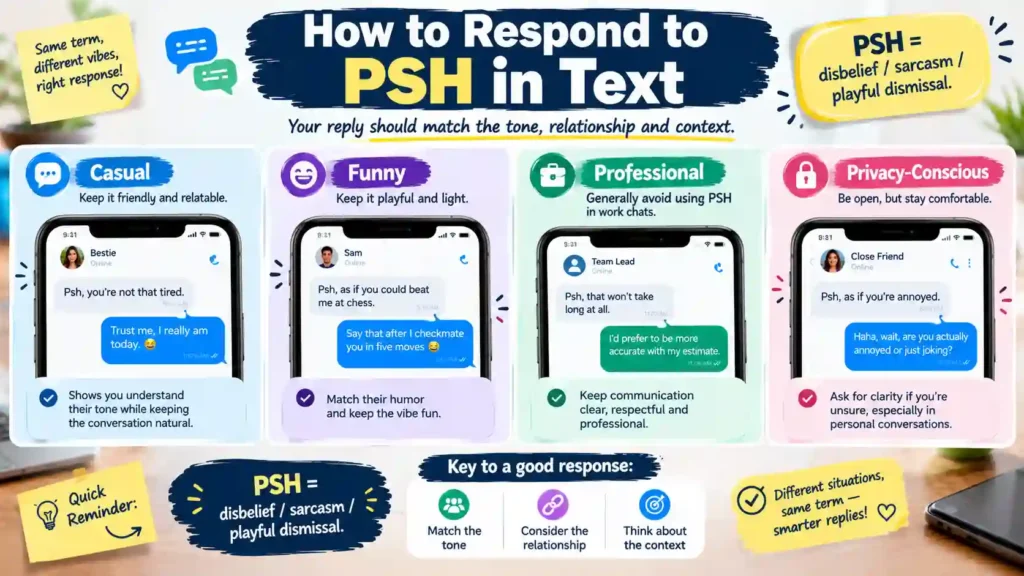
Casual:
Friend: Psh, you’re not that tired.
You: Trust me, I really am today.
Funny:
Friend: Psh, as if you could beat me at chess.
You: Say that after I checkmate you in five moves
Professional:
Psh doesn’t fit workplace communication, so it’s best to avoid it there entirely. If a coworker uses it casually in a relaxed team chat:
Coworker: Psh, that meeting could’ve been an email.
You: Ha, agreed, let’s keep today’s shorter.
Privacy-Conscious:
If you’re unsure whether someone’s “psh” is teasing or slightly annoyed:
You: Haha, wait, are you actually annoyed or just joking?
Matching tone helps keep the exchange light, especially since psh relies so heavily on shared understanding between the people texting.
Regional or Cultural Differences
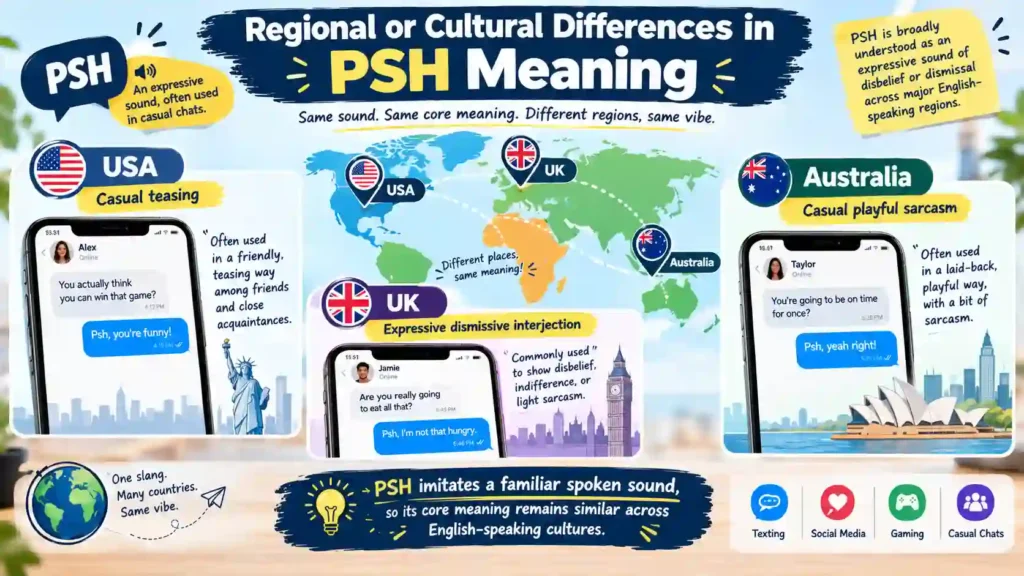
Psh is widely used across major English-speaking regions, including the USA, UK, and Australia, since it stems from a much older, broadly recognized verbal expression rather than newer internet-specific slang.
In the USA, psh appears frequently in casual texting among teens and young adults, often paired with playful teasing.
In the UK, similar dismissive sounds exist in spoken English, and psh fits naturally into that same tradition of expressive interjections.
Because it imitates a universal human sound rather than relying on regional wordplay, psh tends to translate easily across English-speaking cultures.
Comparison with Similar Terms
| Term | Formality | Platform | Risk of Confusion |
| psh | Very casual | Texting, social media | Medium (tone-dependent) |
| pfft | Very casual | Texting | Medium |
| yeah right | Casual | Texting, speech | Low |
| as if | Casual | Texting, speech | Low |
The biggest difference is that psh relies almost entirely on tone and relationship context, making it slightly more prone to misinterpretation than clearer phrases like “yeah right.”
Usage in Online Communities & Dating Apps
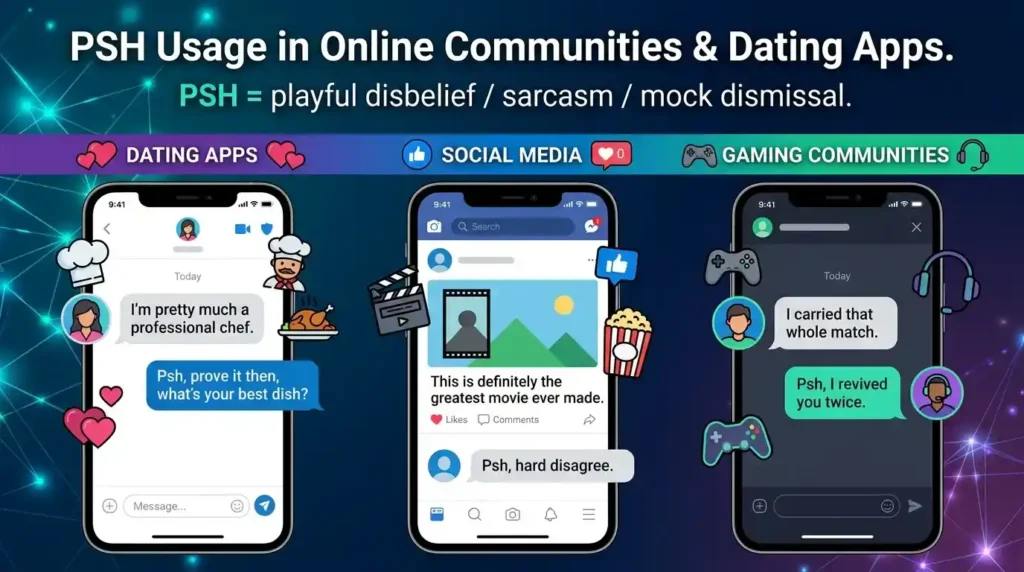
On Tinder or other dating apps, psh sometimes appears in playful, flirty banter.
Match: I’m pretty much a professional chef.
You: Psh, prove it then, what’s your best dish?
On Twitter, psh often appears as a quick, sarcastic reaction to a bold claim or joke post.
User: This is definitely the greatest movie ever made.
Reply: Psh, hard disagree.
In gaming communities, especially Discord, psh is common in light trash talk between friends.
Teammate: I carried that whole match.
You: Psh, I revived you twice.
Tip for responding: On dating apps, pairing “psh” with a playful follow-up question keeps the tone flirty and fun rather than dismissive.
Hidden or Offensive Meanings
Psh doesn’t carry any hidden or inherently offensive meaning. It’s fundamentally an expressive sound representing disbelief or mock dismissal, not a coded phrase with a secret definition.
That said, tone and relationship matter a lot here. Between close friends, it almost always reads as playful. With someone you don’t know well, or in a more serious conversation, it could come across as genuinely dismissive or slightly rude.
Example:
Friend: I’ve been really stressed about this decision.
You: Psh, you’ll figure it out.
In a sensitive moment like this, “psh” might feel dismissive of real feelings, even if that wasn’t the intent. Pairing it with more supportive words helps:
You: Psh, don’t stress, you’ve handled harder things before, and I’m here if you want to talk it through.
Suitability for Professional Communication
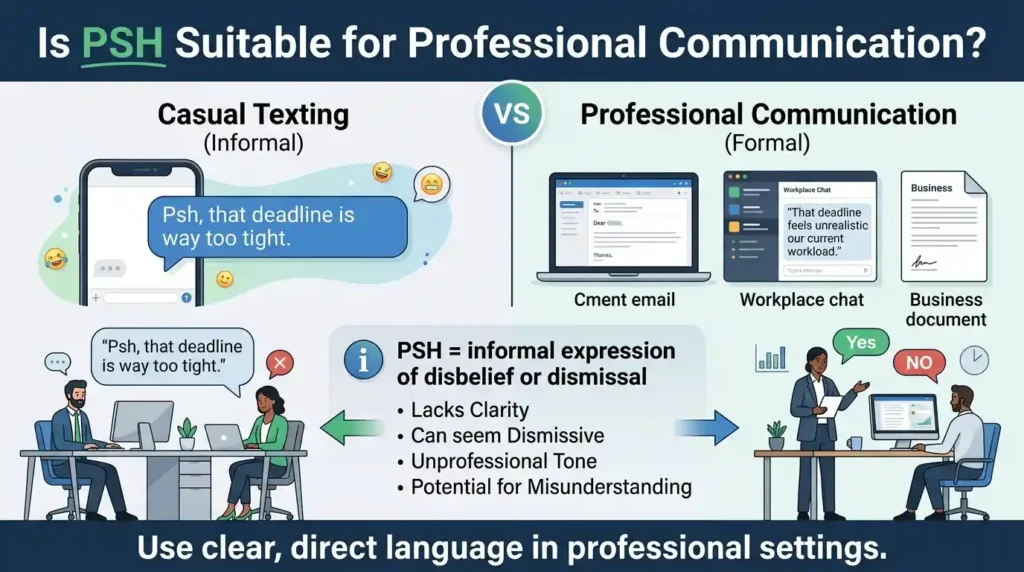
Psh is not suitable for professional communication. It’s an informal, sound-based expression that doesn’t fit the tone of workplace emails or formal messages.
Too casual: “Psh, that deadline is way too tight.”
Better: “That deadline feels unrealistic given our current workload.”
For professional settings, replace psh with clear, direct language that expresses the same sentiment more formally.
FAQs
1. What does psh mean in texting?
It expresses disbelief, sarcasm, or playful dismissal, similar to “yeah right.”
2. Is psh rude?
Not usually. Among friends, it’s typically playful, though tone and context matter.
3. Is psh the same as pfft?
They’re very similar, both representing a dismissive puff-of-air sound in text form.
4. Can I use psh in a work email?
No, it’s far too casual for professional communication.
5. Does psh always mean disbelief?
Mostly, though it can also express mock modesty when brushing off a compliment.
6. Where does psh come from?
It comes from an older spoken interjection, similar to “pshaw,” used to express disbelief long before texting existed.
7. Is psh used the same way everywhere?
Yes, it’s understood similarly across major English-speaking countries, since it stems from a widely recognized verbal sound.
Conclusion
Psh is a small but expressive piece of texting slang, capturing a puff-of-air sound used to show disbelief, sarcasm, or playful dismissal. It fits naturally into teasing, joking, and casual reactions, though it’s best avoided in formal or professional writing.
Understanding psh in text meaning helps you read tone more accurately in casual conversations and respond in a way that matches the playful spirit behind it, whether you’re teasing a friend, reacting to a bold claim online, or brushing off a compliment with a little humor.

Hello,I am Mahrunnisa, a passionate content writer with 2 years of experience in the meaning niche. I love creating simple, clear, and engaging content about words, phrases, expressions, and abbreviations, helping readers understand meanings easily and confidently.