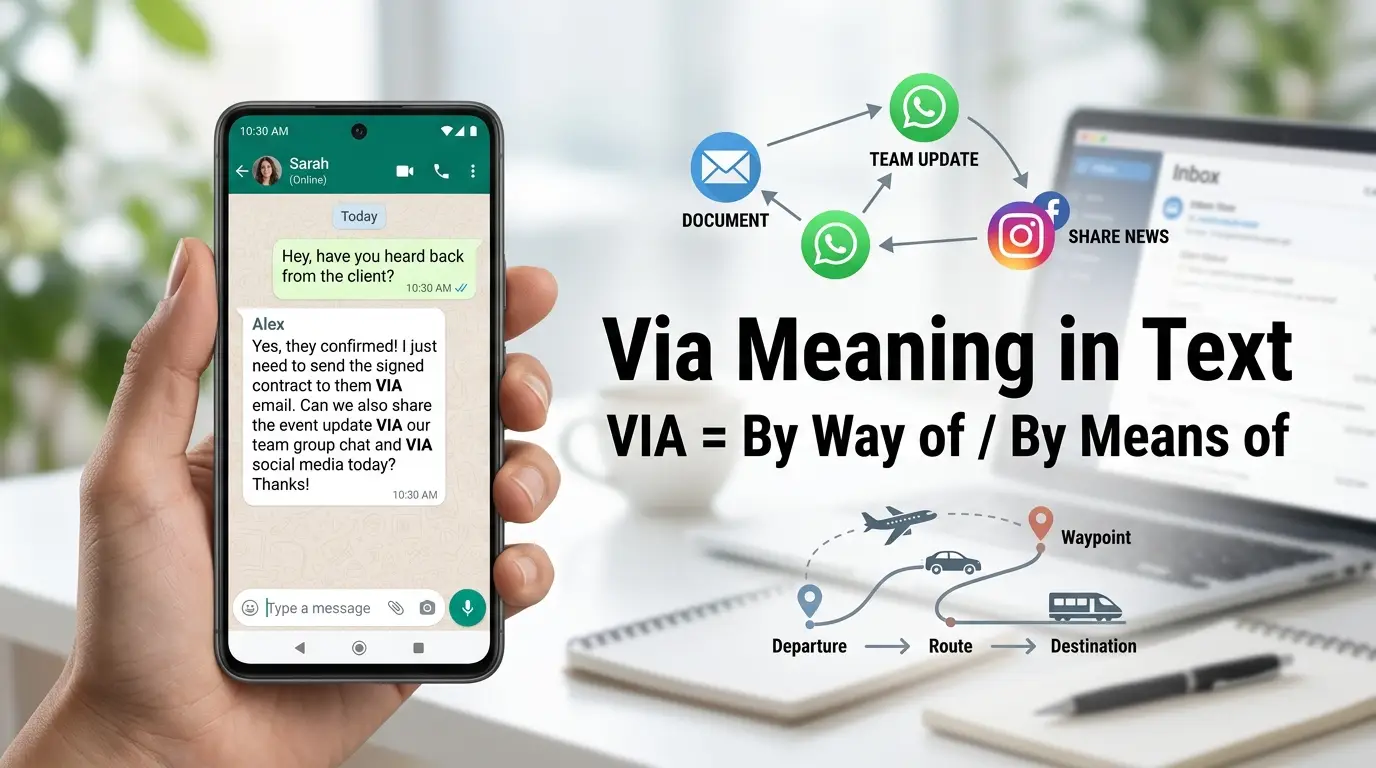
You get a message that says “I’ll send the file via email” or “reached out via DM,” and it feels familiar, but have you ever stopped to think about what “via” actually means?
Via is a small, simple word that shows up constantly in texting, social media, professional messages, and everyday conversation. It’s not flashy slang like LOL or BRB, but it’s used so often that understanding it properly makes your messages clearer and more precise.
You’ll see “via” in texts about how something was sent, on social media captions crediting a source, in gaming updates, and especially in professional emails describing a method or channel. Because it’s a real word borrowed from Latin rather than invented internet slang, it carries a slightly more formal, precise feel than most texting abbreviations.
Understanding “via” matters because it helps you communicate exactly how something happened, whether that’s how a message was delivered, how you found something, or which route you took. This guide breaks down its meaning, history, and how to use it naturally across different everyday situations.
Definition & Meaning
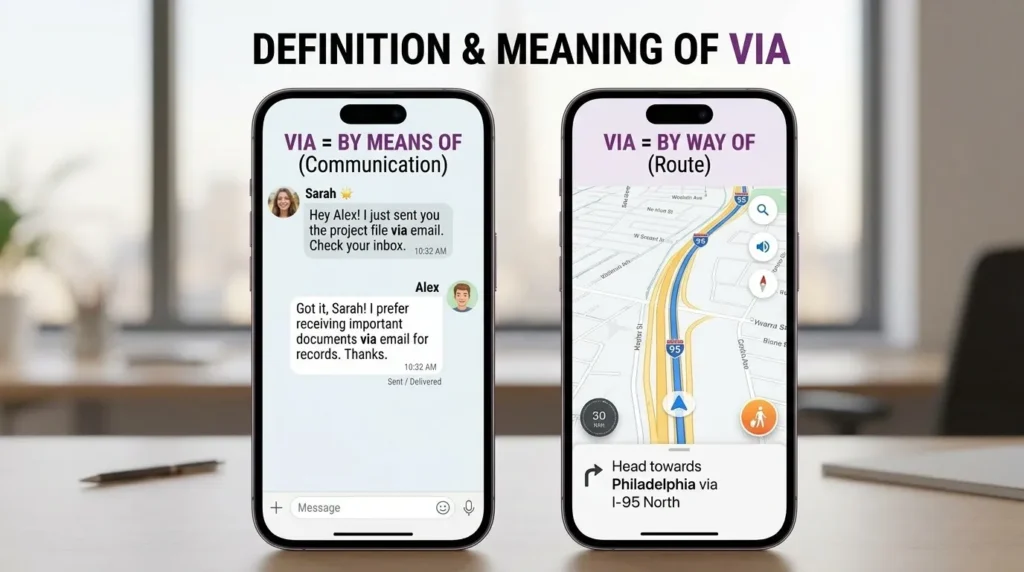
“Via” means “by way of” or “by means of.” It describes the method, path, or channel through which something happens or travels.
There are two main uses of “via” in everyday texting and writing:
- Describing a method of communication or delivery – “I’ll send it via text.”
- Describing a physical route or path – “We drove to the city via the highway.”
Real-life examples:
- Texting a friend: “Sent the pics via WhatsApp, check your messages!”
- Crediting a source: “Photo via @travelwithme on Instagram”
- Giving directions: “We’re getting there via the back road, less traffic”
- Confirming contact: “She reached out via email yesterday”
In modern texting and social media, “via” most often shows up in its communication sense, describing which app, platform, or method was used to send, share, or receive something. On Instagram and other platforms, it’s also commonly used to credit where content originally came from, such as “via @username.”
Unlike slang abbreviations, “via” doesn’t shift meaning based on tone or emojis. Its definition stays consistent whether you’re texting a friend, writing a caption, or sending a work email, which makes it one of the more straightforward terms to use correctly.
Background & History
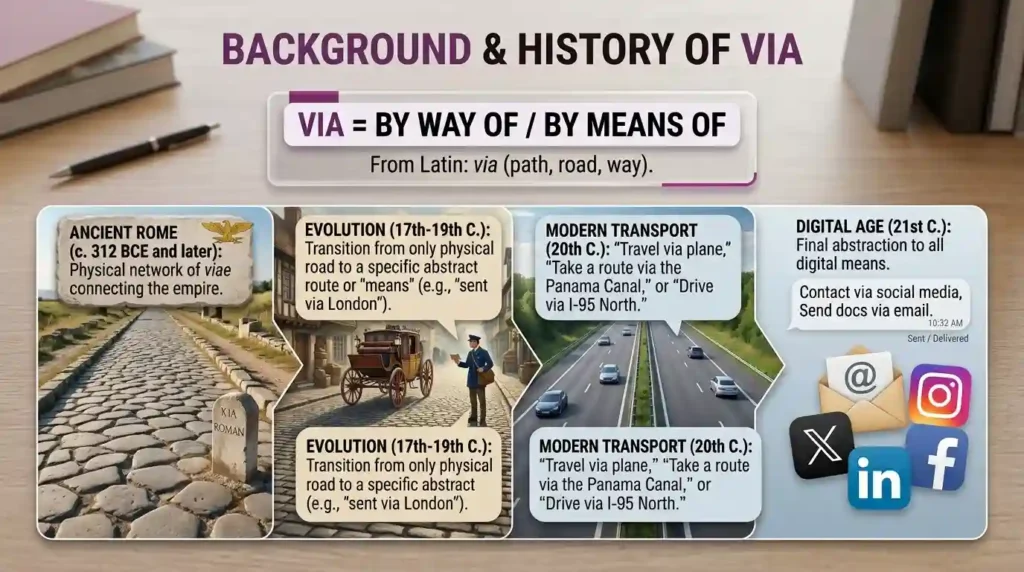
“Via” comes directly from Latin, where it originally meant “road” or “way.” Ancient Romans used it in phrases describing physical roads and routes, and the word eventually made its way into English through everyday and formal usage over centuries, retaining its core meaning of “by way of” or “through.”
For a long time, “via” mostly appeared in formal writing, travel directions, and business language, describing how goods, letters, or people moved from one place to another. It carried a slightly official, precise tone, well-suited to written communication that needed to be clear about method or route.
As digital communication grew, “via” naturally carried over into texting, email, and social media, since the same need still existed: describing exactly how something was sent or discovered. Unlike slang terms that emerged specifically from internet culture, “via” simply adapted an already-existing word to new digital contexts.
Social media accelerated one particular use of “via” even further: crediting sources. As reposting and sharing content became a core part of platforms like Instagram, Twitter, and Pinterest, “via” became the standard, quick way to acknowledge where a photo, quote, or post originally came from.
Today, “via” is commonly used in:
- Texting and messaging apps, describing how something was sent
- Social media captions, crediting original sources
- Professional emails, describing communication channels
- Everyday directions, describing travel routes
Its long history as a real, formally recognized word is exactly why it fits comfortably into both casual and professional writing, unlike most invented internet slang.
Usage in Various Contexts
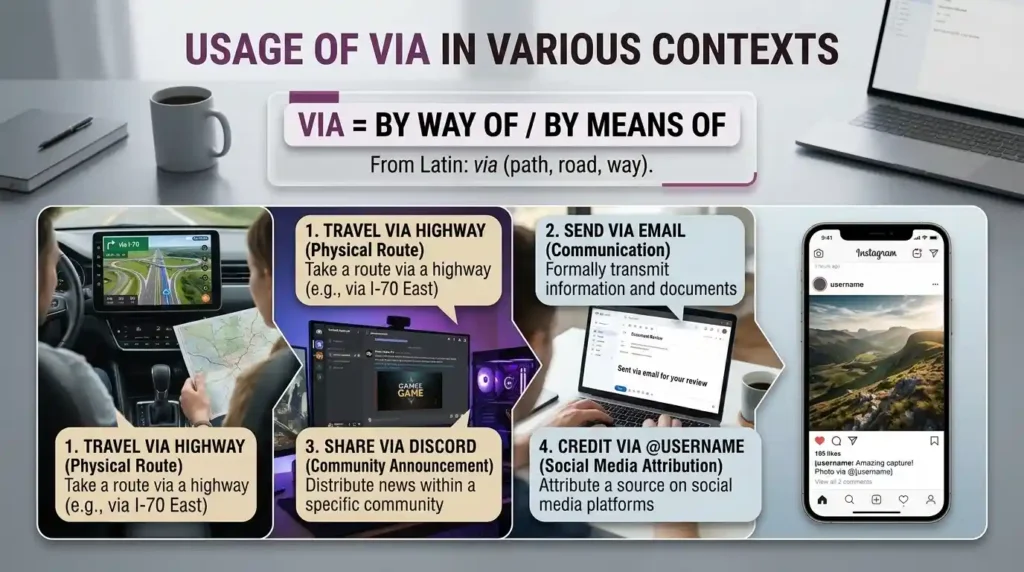
“Via” adapts naturally across different types of conversations and platforms.
In casual texting, it often describes how something was sent:
Sana: did you get the documents? Aleena: yep, sent via email this morning
On social media, it frequently credits a source:
Caption: Sunset views (photo via @naturelens)
In gaming updates or patch notes, it can describe how information was shared:
Announcement: New update details shared via our official Discord
In professional messages, it describes a formal communication method:
Colleague: I’ll follow up via email with the full report
In casual conversation about directions, it describes a physical route:
Friend A: how’d you get here so fast? Friend B: took the shortcut via Main Street
Across these situations, “via” consistently answers the question “how” or “through what method.” Whether it’s an app, a platform, a road, or a communication channel, the word points directly to the means by which something happened.
Common Misconceptions & Clarifications
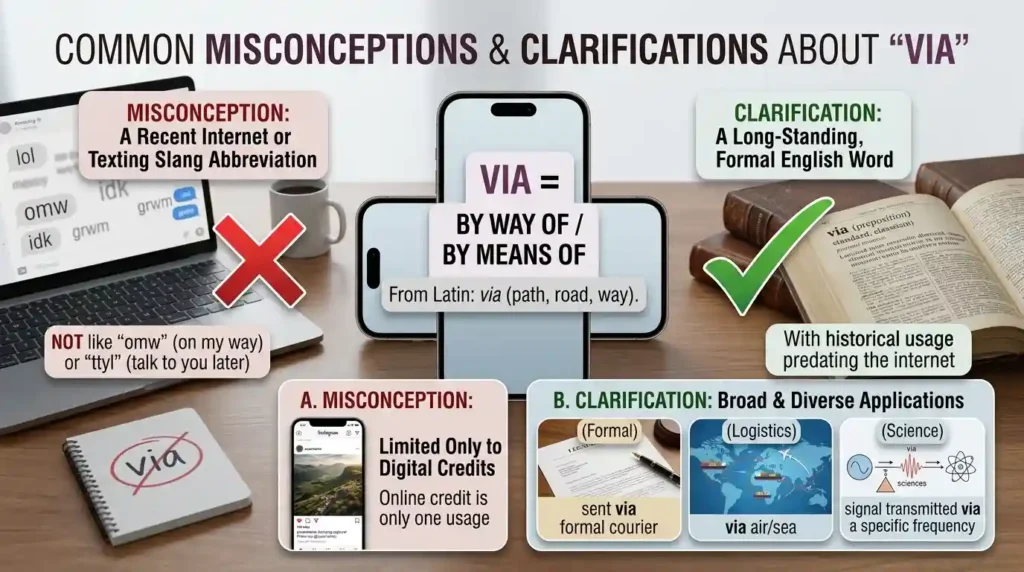
The most common misconception about “via” is assuming it’s internet slang with a hidden or evolving meaning. In reality, “via” is a standard English word with a long, stable history, and its meaning hasn’t shifted the way abbreviations like “lol” or “tbh” have over time.
Another small point of confusion is pronunciation. Some people say “via” as “VEE-uh,” while others say “VY-uh.” Both pronunciations are widely accepted, and neither is considered incorrect, so this variation doesn’t affect the word’s meaning.
People sometimes also wonder whether “via” is interchangeable with “through,” “by,” or “using.” While these words are closely related, “via” specifically emphasizes the route, method, or channel in a slightly more precise or formal way than a general word like “through.”
Is “via” ever inappropriate or misinterpreted? Generally, no. Since it’s a straightforward, neutral word, it doesn’t carry hidden meanings, sarcasm, or tone shifts the way slang terms often do. The main risk isn’t misinterpretation, but simply using it in a context where a more casual word would flow better, such as texting close friends.
Similar Terms & Alternatives
Several related words serve a similar function to “via,” depending on the sentence. Here’s how they compare:
| Term | Meaning | Best Used For |
| Via | By way of / by means of | Formal or precise communication about method |
| Through | Passing by means of something | Casual or formal descriptions of method or path |
| By | Indicating method or means | General, everyday communication |
| Using | Employing a specific tool or method | Clear, direct descriptions of method |
| By way of | Full version of “via” | Formal writing or emphasis |
“Through” is often the more casual, everyday alternative to “via,” especially in texting between friends. “By way of” is simply the full English phrase “via” originally shortened from, so the two are essentially interchangeable, though “by way of” feels more old-fashioned or deliberate.
If you want your message to feel more casual, swapping “via” for “through” or “by” often works well. If you want to sound more precise or formal, “via” remains the stronger choice.
How to Respond to This Term
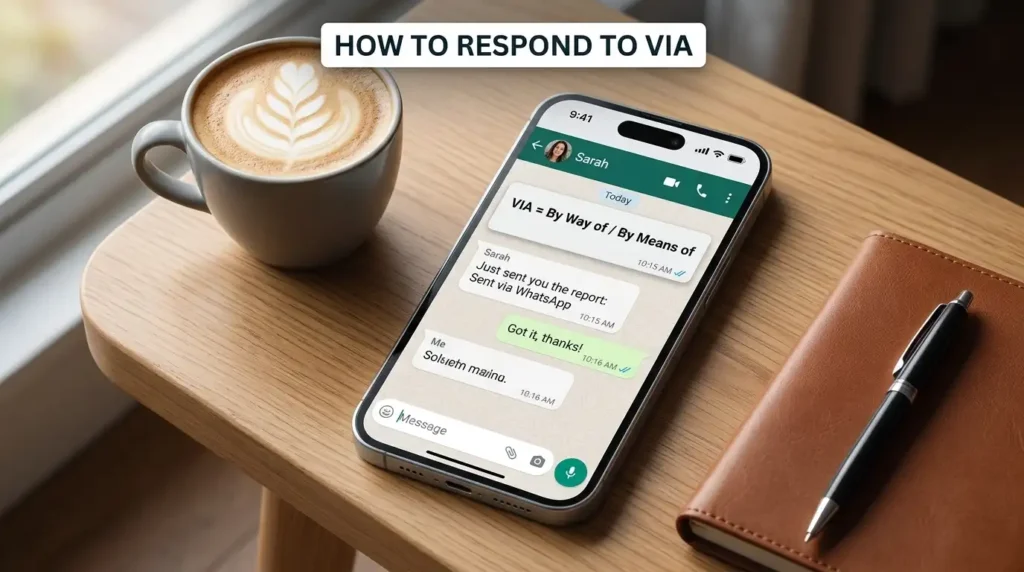
Since “via” is a neutral, functional word rather than an emotional or reaction-based term, responding to it usually means simply acknowledging the method described.
Casual response:
Them: sent the invite via WhatsApp You: got it, thanks!
Funny response:
Them: reaching out via carrier pigeon this time You: haha finally, modern technology has failed us
Professional response:
Them: I’ll send the contract via email by end of day You: Sounds good, I’ll keep an eye out for it.
Privacy-conscious or clarifying response (if the communication method matters for security or preference):
Them: I’ll send your details via text You: Could you send it via email instead? I’d prefer to keep a record.
Since “via” rarely carries emotional weight, responses usually focus on confirming, clarifying, or adjusting the method mentioned, rather than reacting to tone.
Regional or Cultural Differences
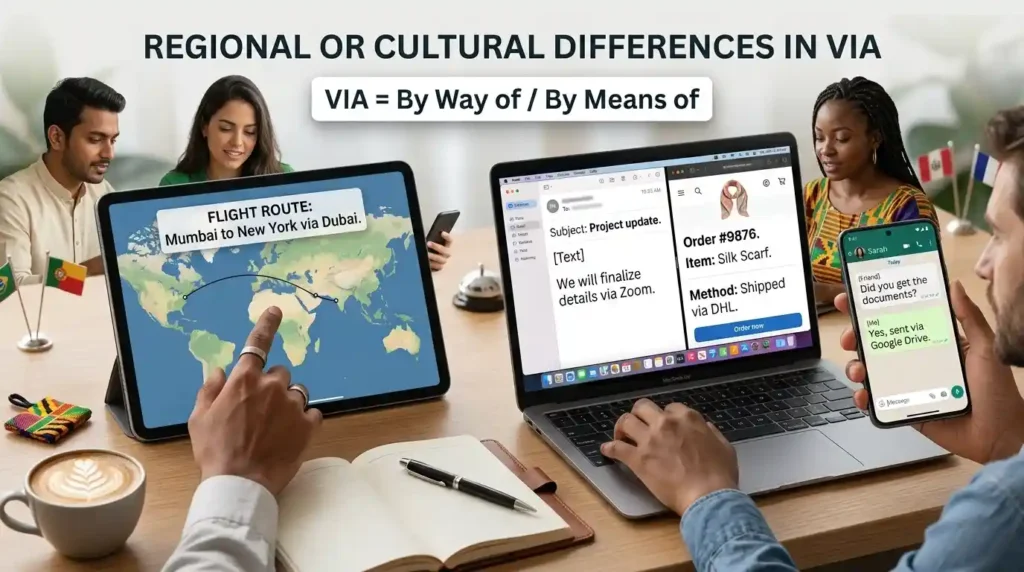
“Via” is widely recognized across English-speaking countries and beyond, largely because it originates from Latin, a language that influenced many European languages directly. This gives “via” a broader international familiarity compared to most internet-born slang terms.
In business and travel contexts especially, “via” is used similarly across many English-speaking regions, from describing flight routes (“flying via Dubai”) to communication methods (“contacted via email”). Its formal Latin roots make it feel appropriate in both casual and professional writing almost universally.
Beyond English, several other languages, including Italian, Spanish, and French, use “via” or very similar forms with related meanings, since they share the same Latin origin. This makes “via” one of the more globally recognizable words on this list, unlike newer, purely internet-born abbreviations.
Because of this shared linguistic history, “via” rarely causes confusion across cultures or regions, especially compared to slang terms that stay confined to specific online communities.
Comparison with Similar Terms
Here’s how “via” compares to other words describing method or route:
| Term | Full Meaning | Formality | Common Setting |
| Via | By way of / by means of | Neutral to formal | Texting, email, social media, travel |
| Through | Passing by means of | Casual to formal | Everyday conversation |
| By | Indicating method | Casual to formal | General communication |
| Using | Employing a method or tool | Neutral | Clear, direct instructions |
Key difference: “via” tends to sound slightly more precise or formal than “through” or “by,” even though all three can technically describe the same idea. This makes “via” a natural fit for professional writing, travel details, and source credits, while “through” or “by” often feel more natural in relaxed, everyday texting.
Usage in Online Communities & Dating Apps
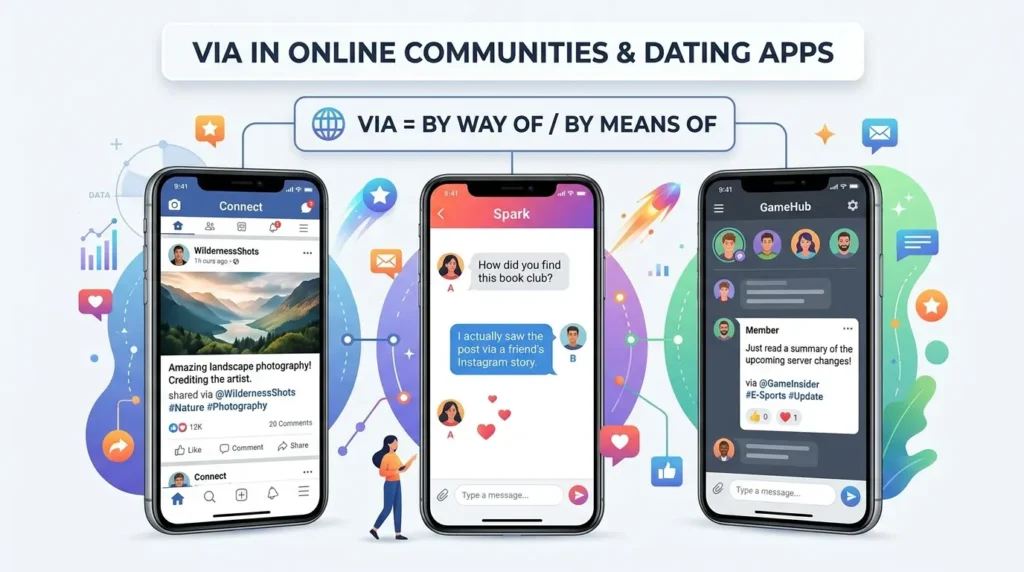
On Twitter/X, “via” is commonly used to credit the original source of a post, article, or piece of information:
Tweet: Fascinating read on renewable energy (via @greenenergynews)
On Instagram, it’s especially common in captions crediting photographers, brands, or original content creators:
Caption: Coffee and cozy mornings (via @slowlivingdaily)
On dating apps like Tinder, “via” rarely appears in casual chat, but might show up when describing how you found or heard about something:
Match: how’d you hear about this new café? You: saw it via a friend’s Instagram story
In gaming communities, “via” often appears in official updates or announcements describing communication channels:
Announcement: Beta access details will be shared via our newsletter
Tips for responding appropriately across these platforms:
- When “via” credits a source, it’s polite to check out or acknowledge the original creator if relevant.
- On dating apps, “via” works naturally when explaining how you discovered something, without needing extra explanation.
- In gaming or community updates, “via” simply tells you where to look for more information, so responding usually isn’t necessary unless you have a follow-up question.
Hidden or Offensive Meanings
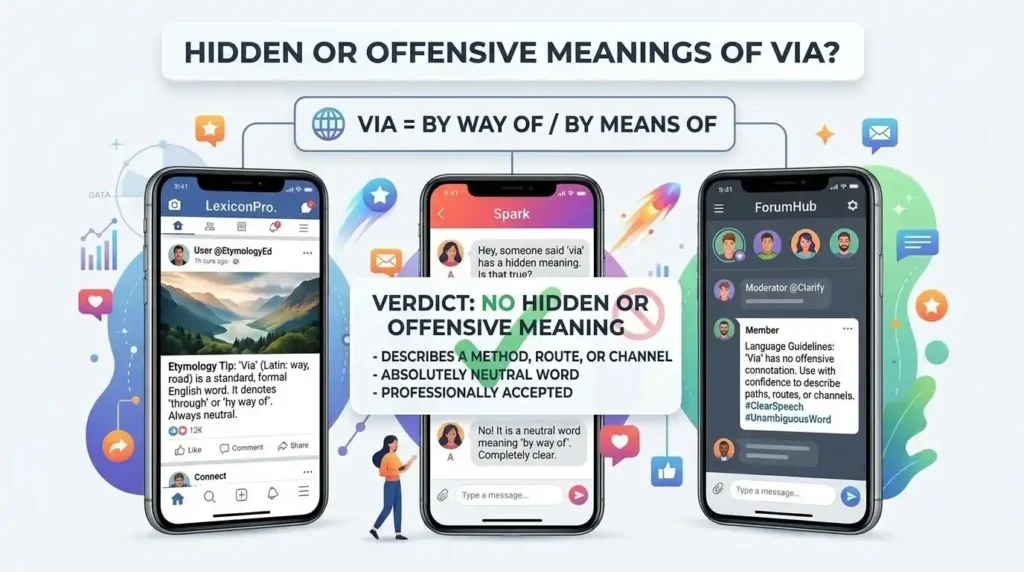
“Via” does not carry any hidden or offensive meaning. As a standard English word with clear, stable Latin origins, it functions purely as a description of method or route, without slang-based double meanings or alternative interpretations tied to tone or internet culture.
Unlike many texting abbreviations, “via” doesn’t rely on context to avoid misinterpretation, since its meaning stays the same whether it’s used casually or formally, sincerely or jokingly.
Why tone still matters, even for a neutral word: While “via” itself carries no hidden meaning, the sentence surrounding it can still carry sarcasm or humor, such as “reaching out via smoke signal” as an exaggerated joke about slow communication. In these cases, the playful tone comes from the surrounding phrase, not from “via” itself, which simply continues to mean “by way of” no matter the context.
Suitability for Professional Communication

“Via” is highly suitable for professional communication. Unlike most texting slang, it’s a properly recognized English word often used in formal writing, business emails, and official documents.
Using “via” in a professional context, such as describing how a document was sent or how a meeting will be conducted, sounds clear, precise, and appropriately formal.
Professional examples:
- “Please find the attached report sent via email.”
- “The meeting will be conducted via video call.”
- “Feedback can be submitted via our online form.”
Because “via” already fits naturally into professional writing, there’s rarely a need to replace it in formal settings. If a slightly more casual tone is preferred, “through” or “by” can serve as softer alternatives, but “via” remains a safe, professional choice in nearly any formal context.
FAQs
1. What does “via” mean in text? It means “by way of” or “by means of,” describing how something was sent, shared, or reached.
2. Is “via” slang? No, it’s a standard English word with Latin origins, unlike typical texting abbreviations.
3. How do you pronounce “via”? Both “VEE-uh” and “VY-uh” are widely accepted pronunciations.
4. Is “via” the same as “through”? They’re closely related, but “via” tends to sound slightly more formal or precise.
5. Can “via” be used in professional emails?Yes, it’s commonly and appropriately used in formal and business writing.
6. Does “via” have any hidden or offensive meaning? No, it consistently means “by way of” without alternative slang interpretations.
7. Why do people use “via” instead of “through” or “by”? “Via” often sounds more precise or formal, making it useful in professional or descriptive contexts.
Conclusion
“Via” is a simple, stable word meaning “by way of” or “by means of,” used to describe how something was sent, shared, or reached. Unlike most texting slang, it comes from Latin and carries the same clear meaning across casual, social, and professional contexts alike.
The key takeaway: “via” is a reliable, versatile word that fits naturally into texting, social media captions, and professional writing without shifting meaning based on tone. Understanding it helps you communicate more precisely, If you’re crediting a source, describing a route, or explaining exactly how a message was sent.

Hello,I am Zarish, a passionate content writer with 2 years of experience in the meaning niche. I create clear, engaging, and easy-to-understand content about words, phrases, slang, abbreviations, and expressions, helping readers understand language with confidence.